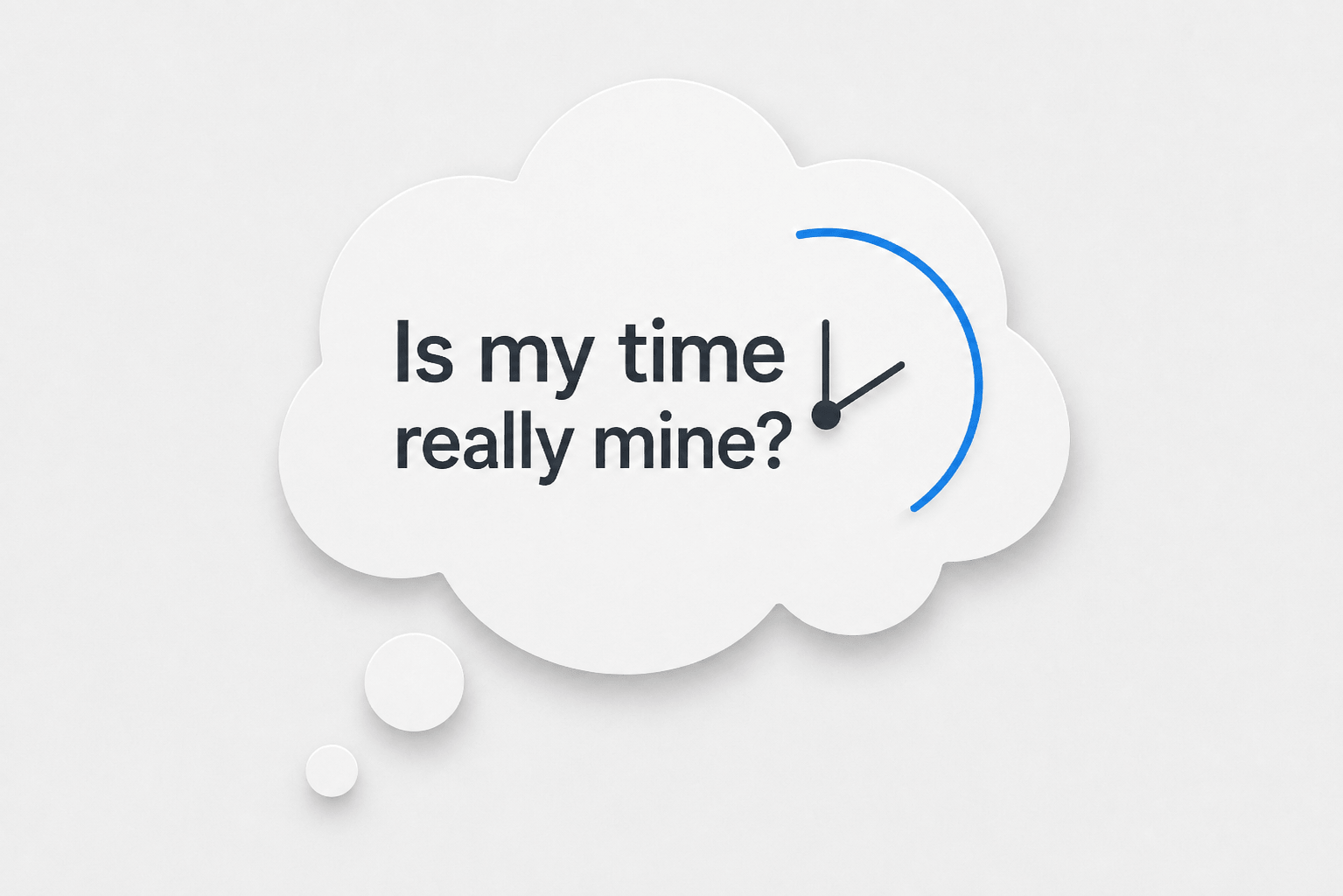
Who Really Controls My Time?
Not only time in the practical sense, like schedules, appointments, work hours, and daily routines. I mean time in a deeper sense. The time we actually feel we own. The time we can choose how to use. The time we have with our family, our health, our interests, our growth, and the things that matter to us.
At some point, I began asking myself a simple but uncomfortable question:
How much of my time do I really control?
That question is not meant as criticism toward any job, business, career, or lifestyle. There is no right or wrong answer that fits everyone. Some people love their work. Some people enjoy being employed. Some people enjoy running their own business. Some people want stability. Some people want more freedom. Some people want a combination of both.
But I think it is still a question worth asking.
Because many of us grow up inside systems that shape how we think about time, money, work, and security. Often, we do not question those systems because they feel normal. We go to school, we are encouraged to get an education, find a good job, work hard, pay our bills, take vacations when possible, and build a life around that structure.
There is nothing wrong with that.
But it may not be the only way to think.
When I was younger, I mostly saw two ways of earning money. Either you became employed, or you became self-employed. That was the world I understood. If you wanted income, you worked. If you wanted more income, you worked more, became better at what you did, or started your own business.
I started working early. I had different small jobs when I was young, delivered advertising and newspapers, and later worked in the kitchen and dish area on a passenger boat. I learned very early that money usually came from exchanging time for income.
Again, there is nothing wrong with that. It is how most of us begin. It is how most of society is structured.
But later in life, when I was introduced to personal development and new ways of thinking about money, time, and business, I began to see something I had not really understood before.
There is a difference between earning money from the time we sell and building something that can create income beyond the exact hours we personally work.
That idea changed how I looked at time.
As an employee, someone else usually decides many parts of the schedule. When to start. When to finish. When vacation is possible. What needs to be done. Where the work happens. How flexible the day can be.
As a self-employed person, there may be more freedom in some areas. But even then, time is often connected to customers, assignments, deadlines, projects, and the need to keep producing income. In many cases, it is still an exchange of time for money, just in another form.
That does not make it bad. It simply means that freedom and income are not always the same thing. A person can earn a good income and still have very little control over their time. A person can own a business and still feel trapped by the demands of that business. A person can have a stable job and still wonder what would happen if something changed outside their control.
That is one of the reasons I believe this topic matters.
Life can change quickly. A company can reorganize. A customer can disappear. A market can shift. A political decision can affect an industry. A health issue can change what is possible. An economy can move in a direction no one expected.
Sometimes things happen that affect our entire lifestyle, even if we did nothing wrong.
That is why I no longer think only in terms of income. I think more in terms of options.
Do I have options?
Do I have a buffer? Do I have more than one way to create income? Do I have skills that can help me adapt? Do I have something I am building for the future? Do I have enough control over my time to live in a way that feels meaningful to me?
Those questions are not always comfortable, but they can be useful.
For me, this is not about telling anyone to leave their job, stop running their business, or change everything immediately. That would be too simple, and life is rarely that simple.
For me, it is more about awareness.
Maybe the first step is not to change everything. Maybe the first step is simply to notice how life is structured.
How much of my week is truly chosen by me? How much is controlled by obligations? How much of my income depends on one source? How much of my time goes to things I say are important, but rarely prioritize? How much of my life is built by design, and how much is simply the result of habits, routines, and expectations I never questioned?
These are important questions because time is not just a practical resource. Time is life.
Time with family. Time with children. Time for health. Time for learning. Time for reflection. Time for meaningful work. Time for adventure. Time to become the person we want to become.
Many people say they want more freedom, but freedom is not only about money. Money can help, of course. But freedom is also about having choices. It is about not being completely dependent on one situation, one employer, one customer, one system, or one way of earning income.
That is why I believe building alternatives can be so valuable.
An alternative does not have to be dramatic. It can start small.
It may be learning a new skill. It may be reading and studying personal development. It may be building better financial habits. It may be saving a percentage of income. It may be investing in knowledge. It may be creating a small project on the side. It may be developing a business slowly over time. It may be building something today that creates more choices tomorrow.
The point is not that everyone should do the same thing.
The point is to begin thinking differently.
If I love what I do today, that is wonderful. But I still want it to be a choice, not a trap.
If I choose to stay in a job, I want that choice to come from clarity, not fear.
If I choose to run a business, I want to build it in a way that creates more freedom, not less.
If I choose to spend my time in a certain way, I want to know that it is aligned with the life I am trying to build.
That, to me, is the real question.
Not whether employment is good or bad. Not whether business is good or bad. Not whether one path is better than another.
The real question is: Am I building a life where I have options?
Because when we have options, we can make better choices. We can stay because we want to, not because we are trapped. We can work because it is meaningful, not only because we have no alternative. We can build slowly without panic. We can think longer term. We can make decisions from a place of strength instead of fear.
I think that is one of the reasons personal development has meant so much to me. It opened my mind to the idea that life does not have to be viewed only through the structure I grew up with. It helped me understand that habits, thinking, skills, leadership, communication, and financial awareness all play a role in creating more options.
And maybe that is where the real value begins.
Not in suddenly changing everything.
Not in judging anyone else’s choices.
But in asking better questions.
What kind of life am I building? Where does my time go? What am I depending on? What would happen if something changed? What could I start building now that might give me more choices later?
For me, this reflection comes back to one simple idea:
I want to own more of my time.
Not because I want to escape responsibility, but because I want to live with more intention. I want my time, work, income, habits, and growth to move in the direction of the life I actually want to build.
Maybe that is something worth thinking about.
Because if time is life, then learning to create more choice around our time may be one of the most important forms of growth.
Related reading: Creating more control over your time often starts with small daily habits. Read: Are Your Habits Changing Your Life?
Want to understand how your choices shape the way you use your time? Learn more about the Decision Style Test.