
·

The Blame Game

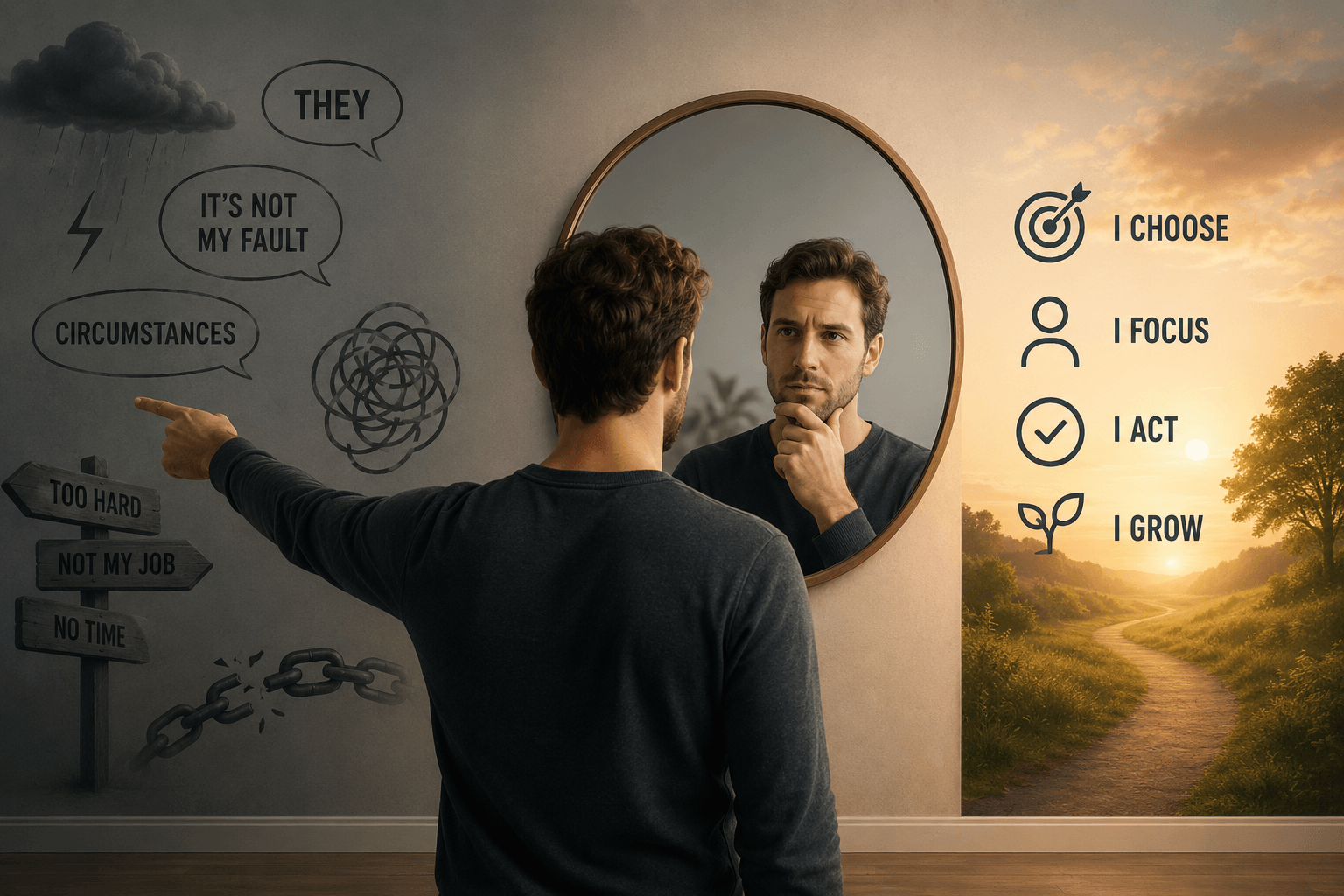
Man moving from blame and excuses toward self-reflection and personal responsibility.


When something does not go our way, it is often easy to find someone or something else to blame.

It was because of my boss. My partner made it difficult. Everyone else does the same thing. I did not have the right opportunity. The circumstances were against me.

Sometimes those things may even be true. There are circumstances in life that we cannot control, and there are things that happen to us that are genuinely not our fault.

But there is a danger when blaming others becomes our normal response. Because the moment everything becomes someone else’s fault, we also remove responsibility from ourselves. And if we have no responsibility, we have no reason to take action.

That is where the blame game can begin to hold us back.

What Can You Actually Control?

I am not saying that everything that happens in our lives is our fault. It is not.

There are things we cannot control. Other people make decisions that affect us. Companies change. Relationships end. We may experience difficult circumstances, illness, loss, or things from our past that we never chose.

But even when we cannot control what happens, we often still have some control over what we do next. That distinction is important.

Instead of asking only, “Whose fault is this?” perhaps a more useful question is:

What can I do about it now?

That question brings responsibility back to us. And with responsibility comes the possibility of change.

The Everyday Blame Game

The blame game does not always appear in major life situations. Often it shows up in very ordinary things.

Imagine that I want to lose weight, but my partner regularly brings home chips, sweets, and other things I am trying not to eat.

I could say: “If my partner did not buy those things, I would not gain weight.”

And yes, perhaps it would be easier if my partner supported my goal and did not bring those things home. But my partner is still not the person putting the food in my mouth. That choice is mine.

Or perhaps I am unhappy with how much I earn.

“My employer will not pay me more.”

That may be completely true. Maybe the company cannot afford to pay more. Maybe they do not believe my current performance justifies a higher salary. Maybe there are other reasons.

But what can I do?

I can ask what I need to improve. I can develop new skills. I can become better at what I do. I can look for another position. I can find another way to increase my income.

I may not be able to control what my employer decides. But I can control what I decide to do next.

The same applies to something as simple as arriving late to work.

“But everyone else comes late.”

Maybe they do. But everyone else is not responsible for when I arrive. I am.

Responsibility Gives You Options

This is why I believe the blame game can be so damaging when we want to change our lives. Not physically damaging, perhaps, but damaging to our growth.

If I constantly believe that other people are responsible for where I am, then I also give those people control over whether my life can change.

I want more freedom, but someone else is stopping me. I want better health, but someone else makes it difficult. I want a better career, but my employer will not give me the opportunity. I want to fulfil my dreams, but my circumstances are wrong.

If everything depends on someone else changing first, I may wait for a very long time.

But when I begin asking what I can change, something happens. I get options again.

Not always easy options. Not always quick ones. But options.

What Are Your Mistakes Teaching You?

Blaming others can also prevent us from learning from our mistakes.

John C. Maxwell wrote a book called Failing Forward, built around the idea that failure and mistakes can become part of our growth when we learn from them.

I believe there is a lot of truth in that.

We are going to make mistakes. I have made many, and I will make more. But if every mistake immediately becomes somebody else’s fault, what am I supposed to learn from it?

If I say, “It happened because of them,” I can walk away without examining my own decisions.

If instead I ask, “What could I have done differently?” I may discover something that helps me the next time.

That does not mean taking responsibility for things that genuinely belonged to someone else. It means being willing to look honestly at the part that belonged to me.

Sometimes the Blame Goes Back Years

The blame game can also reach much further back. We can blame our childhood, our parents, previous relationships, lost opportunities, or things that happened many years ago.

This is something I can relate to personally.

I had a difficult childhood, and of course experiences from those years affected me. I cannot pretend they did not.

But at some point I had to ask myself another question:

Why should I allow what happened then to decide the rest of my life?

I cannot change what happened. I cannot go backwards and create another childhood. But I can decide what I want to do with my life from here.

The past may explain some of the way we think, react, or behave today. Understanding that can be important. But explanation does not have to become a life sentence.

At some point, if I want something different, I have to begin taking responsibility for building something different.

That is part of the inner journey.

Change What You Can Change

Sometimes we make change much more complicated than it needs to be.

I do not have enough money. What can I change?

I am unhappy with my health. What can I change?

I do not like where my career is going. What can I change?

I keep ending up in the same situation. What can I change?

Notice that I am asking what, not how. Many people get stuck at “How am I going to do this?” and immediately see everything they do not have or cannot do. First become clear about why you want the change and what you want to change. When your why and your what are clear, the how often becomes easier to see.

The answer may not be immediate, and the solution may require time, effort, learning, difficult conversations, or uncomfortable decisions.

But blaming someone else rarely moves us forward.

A fast-food restaurant is not responsible for the fact that I stopped there when I was hungry. The restaurant can be directly on my way home, with a huge sign in front of me, but I am still the one who turns the car into the parking lot.

That does not mean every choice is easy. It means it is still a choice.

Step Out of the Blame Game

Perhaps one of the most useful things we can do is become aware of how often we blame circumstances or other people.

Not so that we can start blaming ourselves instead. That is not the point.

The point is to recognise where our own responsibility begins.

When something goes wrong, we can ask:

What part of this could I control?
What could I have done differently?
What can I learn from it?
What can I do now?

There will always be things outside our control. But we do not need to give those things control over everything that happens next.

Taking responsibility does not change the past.

It changes what we are able to do with the future.

—

Related reading: Growth often requires us to look at our own patterns before looking at everyone around us. Read Understand Yourself First.

Do you tend to act quickly, avoid decisions, or look outside yourself when choices become difficult? Explore the Decision Style Test.

How do you respond when things go wrong or emotions become difficult? Explore the Emotion Style Test.


Was this article helpful?
YesNo

Similar Posts

  • |

    A Good Income Is Not the Same as Freedom

    A person can earn a good income and still have very little control over their time. A person can own a business and still feel tied to customers, assignments, and the need to keep producing income.

    That is something I have been thinking about. Because earning money and having freedom are not always the same thing.

    When I was younger, I mostly saw two ways of earning money. You became employed or you became self-employed. If you wanted income, you worked. If you wanted more, you worked more, became better at what you did, or started your own business.

    Later, I began to understand the difference between earning money from the time we sell and building something that can create income beyond the exact hours we personally work.

    That changed how I looked at time.

    As an employee, someone else usually decides many parts of your schedule. As a self-employed person, you may have more freedom in some areas. But customers, deadlines, and assignments can still decide much of your day.

    There is nothing wrong with either path. But owning a business does not automatically mean owning more of your time.

    For me, the question has become less about income alone and more about options.

    Do I have enough control over my time to live in a way that feels meaningful to me? What am I depending on? What would happen if that situation changed?

    Time is not only something we use to work. It is time with family, time for health, time for learning, and time for the things we want to experience in life.

    I may enjoy what I do and still want more choice around those things.

    This does not mean leaving a job or changing everything immediately. An alternative can begin with learning a skill, developing better financial habits, or slowly building a project alongside what we already do.

    The point is not that everyone should do the same thing. The point is to consider what might give us more choices in the future.

    If I enjoy my job, I want to stay because I want to. If I run a business, I want to understand whether it is giving me the freedom I hoped for.

    For me, a good income can be valuable. But I also want time to live the life I am working to build.

    Related reading: Creating more options can begin with investing in your own knowledge and skills. Read: Your Best Investment

    Was this article helpful?
    YesNo
  • | |

    Understand Yourself First

    Personal development is often connected to books, habits, discipline, goals, leadership, and taking action. All of those things matter.

    But I believe there is one part that is easy to overlook.

    Understanding yourself.

    Because if we do not understand ourselves, it becomes much harder to understand why we act the way we do, why some habits work for us and others do not, why certain goals motivate us while others create resistance, and why communication with other people sometimes becomes more difficult than it needs to be.

    That is one of the reasons I believe self-awareness is such an important foundation for personal growth.

    We can read a good book. We can listen to great advice. We can set goals. We can decide to change. But if we do not understand ourselves, we may still try to build our life in a way that does not really fit how we are wired.

    This does not mean that personality should become an excuse. It does not mean we should say, “This is just who I am,” and avoid growth.

    It means the opposite.

    When we understand ourselves better, we can grow in a smarter way.

    For example, when we talk about habits, it is easy to think that the same method should work for everyone. Wake up earlier. Follow the same routine. Use the same system. Set the same kind of goals. Measure progress the same way.

    But people are different. Some people are motivated by structure. Some need more flexibility. Some are driven by results. Some need meaning and connection. Some people like detailed plans. Others feel trapped by too many details. Some people move quickly and adjust as they go. Others need time to think before taking action.

    None of this is right or wrong. It is simply different.

    That is why I think personality tests and personality tools can be valuable. Not because they define everything about us, but because they can give us language for things we may already feel but have not clearly understood.

    A good personality tool does not put a person in a box. It helps a person understand the box they may already have been living inside without noticing it.

    When we begin to understand our own personality style, we can start asking better questions.

    Why do I react this way? Why do I avoid certain things? Why do I get energy from some situations and lose energy in others? Why do I communicate well with some people but struggle with others? Why do certain goals inspire me, while other goals feel heavy even when they are important?

    These questions can create real value.

    Because personal growth is not only about pushing harder. Sometimes it is about understanding better.

    If a person sets a goal in a way that does not fit their personality, the goal may be good, but the approach may be wrong. Then they may become frustrated and think they lack discipline, motivation, or willpower.

    But maybe the real issue is not the goal. Maybe the real issue is the system around the goal.

    A person may need more structure. Another person may need more freedom. One person may need accountability. Another may need a clear personal reason. One person may need a detailed plan. Another may need a simple first step.

    The same goal can require different paths depending on the person.

    That is one of the reasons I believe self-awareness can make habits stronger. When we understand ourselves better, we can design habits that have a better chance of lasting.

    We can stop copying everything from someone else and start asking:

    What works for me? What kind of environment helps me? What usually stops me? What gives me energy? What makes me lose focus? What kind of support do I need?

    That is not weakness. That is wisdom.

    The same is true with communication.

    Many conflicts do not happen because people are bad people. They happen because people see things differently, process information differently, make decisions differently, and communicate differently.

    One person may speak directly and think they are being clear. Another person may experience that same directness as pressure.

    One person may need facts and details before making a decision. Another person may want the big picture first.

    One person may want fast action. Another may need time to reflect.

    One person may show care by solving problems. Another may show care by listening.

    When we do not understand these differences, it is easy to misunderstand each other. We may think someone is difficult, uninterested, too slow, too intense, too emotional, too cold, too detailed, or too careless.

    But sometimes they are simply different from us.

    When we understand personality styles, we can become better at meeting people where they are. That can help at work. It can help in leadership. It can help in business. It can help in friendships. It can help in family life. It can even help with children, because a child may not communicate, learn, or respond in the same way as the parent.

    If we only communicate from our own style, we may miss the other person. But if we learn to understand their style, we may find a better way to reach them.

    That does not mean we must change who we are. It means we become more aware of how our message is received.

    For me, that is one of the strongest reasons to learn more about personality. It helps us understand ourselves, but it also helps us understand others.

    And when we understand others better, we often judge less and communicate better.

    Of course, a personality test is not the whole truth about a person. No test can explain everything. People are complex. We have different experiences, values, habits, backgrounds, fears, strengths, and dreams.

    Most of us are also a combination of several styles. We are not only one thing.

    That is important to remember.

    A personality tool should be used as a guide, not as a label. It should open reflection, not close the conversation. It should help us grow, not limit who we can become.

    That is why I think the real value is not only in taking a test. The value comes from what we do with the insight afterward.

    Do we reflect on it? Do we recognize patterns? Do we use it to improve our habits? Do we use it to communicate better? Do we use it to set goals in a way that fits us better? Do we use it to understand other people with more patience?

    That is where the growth begins.

    I also think it can be useful to revisit self-awareness over time. We may not become a completely different person, but we do grow. We go through new experiences. We develop new skills. We become more mature in some areas. We may notice patterns that we did not see before.

    That is why self-awareness is not something we do once and then finish. It is something we return to.

    The more we learn about ourselves, the better equipped we become to build the life we want.

    If we want better habits, it helps to understand what kind of structure supports us. If we want better goals, it helps to understand what truly motivates us. If we want better communication, it helps to understand how we naturally express ourselves and how others may receive it. If we want better relationships, it helps to understand that not everyone thinks, feels, or responds the same way we do. If we want better leadership, it helps to understand both ourselves and the people we lead.

    This is why I believe understanding yourself is not a small thing.

    It is a foundation.

    Because when we understand ourselves, we can build better habits. We can make better decisions. We can communicate with more awareness. We can set goals in a way that fits us better. We can stop fighting parts of ourselves and start working with ourselves instead.

    And when we understand ourselves better, we also become more capable of understanding others.

    That may be one of the most valuable parts of personal growth. Not only becoming better for ourselves, but becoming easier to understand, easier to work with, and better at understanding the people around us.

    So before we only ask what habit we should build, what goal we should set, or what result we want to create, maybe we should also ask:

    Do I understand myself well enough to build this in the right way?

    Because sometimes the next step in growth is not only to do more. Sometimes the next step is to understand more.

    And that understanding can change how we build everything else.

    Want to understand how your natural personality shapes the way you build habits, set goals, communicate, and relate to others? Learn more about Core Color Personality Test.

    Was this article helpful?
    YesNo
  • |

    Be the Bridge

    Sometimes something feels easy when we do it as part of a job, but much harder when we do it for ourselves. At work, we may have no problem calling someone, sending an email, starting a conversation, or presenting an idea. We are representing a company or completing a task. But when we begin building something of our own, the same actions can suddenly feel personal.

    The phone feels heavier. We hesitate before sending the message. We begin wondering what the other person will think, how they will respond, and what their answer might say about us. A simple no can begin to feel like personal rejection. But perhaps there is another way to see it.

    Imagine a Backpack

    Imagine placing everything you have to offer inside a backpack. It could be a product, a service, an opportunity, an idea, knowledge, experience, or something else that can create genuine value for another person. You put the backpack on and carry it with you.

    When you contact someone, you are not asking them to approve of you. You are simply giving them the opportunity to look at what you carry. You are the messenger. You are also the bridge between the person and what is inside your backpack.

    Your responsibility is to build that bridge and make the offer honestly. Their responsibility is to choose.

    A No Is Not Always About You

    Think about how people choose grocery stores. Some people regularly shop at one store and would never choose another. Someone else may make the opposite choice. That does not mean either store has no value. People make different choices based on their preferences, needs, experiences, priorities, and current circumstances.

    It will be the same with what you carry. Some people will say yes. Some people will say no. Some people may say not now.

    Some will, some won’t—so what?

    Their answer does not automatically define the value of what you offer. More importantly, it does not define your value as a person.

    There is a saying I have learned through the business I do:

    “We are looking for the people who are looking for us.”

    That does not mean sitting still and waiting for those people to appear. We still need to reach out. We still need to start conversations and build bridges. But we do not need everyone to choose what we carry.

    Know the Value of What You Carry

    This way of thinking also comes with responsibility. Your backpack should contain something you genuinely believe can create real value for the people you approach.

    If you know that what you offer cannot help them, then confidence is not what you are building. You are simply creating false expectations.

    Before becoming proud of what you carry, make sure it is worthy of that pride. Understand what you offer, why it matters, and how it may help someone.

    When you are secure in that knowledge, reaching out can begin to feel different. You are not trying to mislead anyone or force them into a decision. You are offering them the opportunity to look at something you honestly believe may have value. They are still free to choose.

    Putting on the Backpack

    The backpack is not only an image. It can become a mental tool. Before making a call, sending a message, or starting a conversation, pause for a moment. Imagine putting on the backpack. Remind yourself that you are carrying something you believe in. Then remind yourself of your role:

    You are not responsible for making the other person say yes. You are not responsible for their timing, priorities, previous experiences, or personal preferences. You are responsible for taking the step, building the bridge, and giving them the opportunity to look.

    This can help create some distance between your identity and their answer. A no may still feel disappointing. But it does not need to become a judgment about who you are.

    Self-Leadership Through Action

    Some people find it easy to approach others without overthinking. For others, it requires courage. Neither person should be judged. We all carry different experiences, fears, strengths, and beliefs about ourselves.

    Self-leadership is not always about feeling confident before we act. Sometimes it means learning to guide ourselves through uncertainty and act even when confidence is not yet there.

    The more often you take the step, the more natural it can become. You begin learning that you can handle a no. You begin separating other people’s choices from your own value. You begin building confidence through action.

    The next time you feel uncertain about contacting someone, picture the backpack. Remember what you carry. Remember why you believe it has value. Put the backpack on, build the bridge, and take the next step.

    Your responsibility is to offer. Their responsibility is to choose.


    Related reading: Our fear of rejection is often connected to our need to feel accepted and understood. Read The Need for Acceptance.

    Do your emotions sometimes influence whether you take action or hold yourself back? Explore the Emotional Style Test.

    Want to understand how you lead yourself when something feels uncomfortable or uncertain? Explore the Leadership Style Test.

    Was this article helpful?
    YesNo
  • |

    When You Grow, Your Relationships May Change

    When you begin working on yourself, you may notice that something changes in the conversations around you.

    You read, study, and begin looking at life differently. You become interested in development, dreams, goals, and what you want your future to look like.

    Then you sit down with the same friends you have always spent time with, and it does not quite feel the same.

    It can still be pleasant. You can still enjoy being together. But the conversations may no longer give you what they once did.

    Perhaps you want to talk about something you are learning, something you want to build, or a possibility you have started to see. But the people around you are not thinking about those things in the same way.

    That can feel lonely. You have begun seeing another perspective, but it is difficult to explain it to people who do not share that interest.

    I can recognise this in my own life. Personal development has become something I spend time reading and thinking about. But I do not think any of my friends have picked up the kinds of books I am talking about.

    So we are not necessarily coming into the conversation with the same thoughts or interests.

    Sometimes the hardest reactions come from the people closest to us. Family, friends, or colleagues.

    They may have known us since childhood or school. They know the person we have been, and it can be difficult when we begin wanting something different.

    We may feel that they are pulling us back toward what is familiar. At the same time, they may feel that we are pulling away from them.

    That can be a difficult situation. It is still nice to spend time together, but it can also be frustrating when no one seems to understand what we are thinking about or where we want to go.

    Of course, having a new perspective does not mean everything we try will work. It may not turn out the way we hope.

    But we still want to explore something different. We want to develop. We have seen a possibility that matters to us.

    If you are building something or working toward your goals and dreams, I think it helps to understand that the people around you may not come along with you in the way you hoped.

    For me, that means coming back to what I want to do. Keeping my goals and dreams clear in my mind and continuing to work toward them.

    It can be difficult when the people closest to you do not understand your direction. But you still have to decide what you want to do with your own life.

    Related reading: The people around us may not share the vision we are working toward. Read: Your Vision Is Yours

    Was this article helpful?
    YesNo
  • |

    Are Your Habits Changing Your Life?

    Are Your Habits Changing Your Life?

    I’ve written before about discipline, but lately I’ve started thinking more about habits and how small daily actions can change your life.

    For many people, discipline sounds restrictive. It feels like forcing yourself to do things you don’t want to do. That’s why I’ve started thinking about it differently. Instead of focusing on discipline, I focus on habits.

    Two books have influenced my thinking more than most when it comes to habits and personal growth: Atomic Habits by James Clear and The Slight Edge by Jeff Olson. Although they approach the topic differently, they both point to the same truth: small actions, repeated consistently over time, can create remarkable results.

    For years, I searched for motivation. Whenever I felt stuck, I would set new goals, create new plans, and look for ways to become inspired again. The problem was that motivation always seemed temporary. It would work for a while, sometimes for a few weeks, sometimes for a few months, and then it would disappear.

    Eventually, I realized that motivation is a wonderful feeling, but a poor foundation. Habits are much stronger.

    Today, my focus is not on feeling motivated. My focus is on building habits that naturally lead to the next action.

    One of the most useful concepts I’ve learned from Atomic Habits is habit stacking. The idea is simple: one habit becomes the trigger for the next.

    My morning routine follows this principle. I wake up, take care of my morning routine, step on the scale, get dressed, drink a glass of water, put on my shoes, start an audio program, and head out for a walk.

    The walk isn’t really the goal. The goal is to follow the sequence. Each small action naturally leads to the next one.

    When I get home, I prepare breakfast while continuing to listen to the audio. After breakfast, I clear away the dishes, sit down, and begin reading.

    That reading habit has become one of the most valuable parts of my day.

    Every morning I spend approximately 90 minutes reading and studying. Right now, I am reading How to Win Friends and Influence People and reviewing highlights from The Magic of Thinking Big, The Slight Edge, and Atomic Habits.

    Ninety minutes may not sound like much, but over the course of a year, those ninety minutes become more than 547 hours.

    That’s almost fourteen full-time working weeks invested in learning and personal growth. It’s enough time to read and study somewhere between 35 and 55 books, depending on their length and complexity.

    Think about that for a moment.

    How do you think your life would change if you spent the next year studying 35 to 55 books on leadership, communication, habits, psychology, personal growth, or success?

    Do you think you would think differently? Do you think you would make different decisions? Do you think you would see opportunities that you currently overlook?

    I certainly believe you would.

    Another habit I’ve introduced is journaling my days. This is something I’ve read about in several personal development books, and John Maxwell also talks about the value of reflection. But for me, this is still a new habit.

    In the past, I often read books without stopping long enough to reflect, write things down, and apply what I was learning. Now I’m beginning to journal what I do, where my time goes, and what I actually learn from the material I study.

    One of the biggest surprises was discovering that I had more available time than I thought. Once I started tracking my days, I could clearly see what moved me forward and what didn’t.

    Many of us believe we don’t have enough time. Sometimes the real problem isn’t time. It’s that we don’t know where our time is going.

    This connects directly to one of the core ideas in The Slight Edge: small actions matter.

    The small things we do every day often seem insignificant in the moment. Reading ten pages. Listening to an audio. Going for a walk. Spending a few minutes learning something new.

    None of those actions seem life-changing. Yet over time, they compound.

    The same principle works in reverse. If we stop learning, stop growing, and stop investing in ourselves, the decline is usually so gradual that we barely notice it.

    That’s why I believe habits are far more important than motivation. Motivation comes and goes. Habits remain. And over time, those habits shape who we become.

    Many people spend years trying to change their circumstances while ignoring the daily actions that create those circumstances.

    Real change usually starts much smaller.

    It starts with a single habit.

    Then another.

    And another.

    The goal isn’t to become perfect overnight. The goal is simply to move forward, one small step at a time.

    In my next blog, I’ll explore something I’ve understood for many years, but have started approaching differently: books, learning, and the difference between simply reading a book and truly studying it.

    Related reading: Habits become easier to maintain when we understand what discipline really is. Read: Discipline Is Not What Most People Think.

    Want to understand what keeps you motivated and helps you follow through on the habits that move you forward? Learn more about the Goal Style Test.

    Was this article helpful?
    YesNo
  • Fear and Doubt Are Part of Growth

    When you build something and put it out into the world, you expose yourself.

    It doesn’t matter if it’s a business, a blog, a video, or simply sharing your thoughts publicly. The moment you make something visible, you also open yourself up to opinions, reactions, and judgment.

    And that can create doubt.

    I’ve experienced that many times while building Equipido. Even when you know you have something valuable to share — years of experience, education, and reflection behind it — there can still be that quiet voice asking:

    How will people react?
    What will they think?

    Those thoughts are natural. They are part of being human.

    But the deeper truth is that fear and doubt often come from something much older and deeper. Many times they are connected to acceptance — the desire to be understood, appreciated, or simply not rejected.

    The problem is that if fear and doubt begin to control our decisions, they can quietly hold us back.

    Whether we want to start a business, create something meaningful, or grow as individuals, there will always be uncertainty. Waiting until everything feels comfortable or safe usually means waiting forever.

    Growth almost always requires doing something that feels uncomfortable.

    And the reality is simple: if we only stay in situations that feel safe, predictable, and comfortable, we rarely move forward.

    Progress happens when we step into situations where we don’t have full control, where we might be judged, and where things might not turn out exactly as planned.

    That doesn’t mean fear disappears.

    It simply means we choose to move forward anyway.

    Related reading: Being visible often brings fear and doubt. Read: The Courage to Be Visible.

    Want to understand how your emotional patterns shape the way you respond to fear, doubt, and uncertainty as you grow? Learn more about the Emotional Style Test.

    Was this article helpful?
    YesNo

Leave a Reply

Your email address will not be published. Required fields are marked *