How Shifting Your Mind Changes Everything

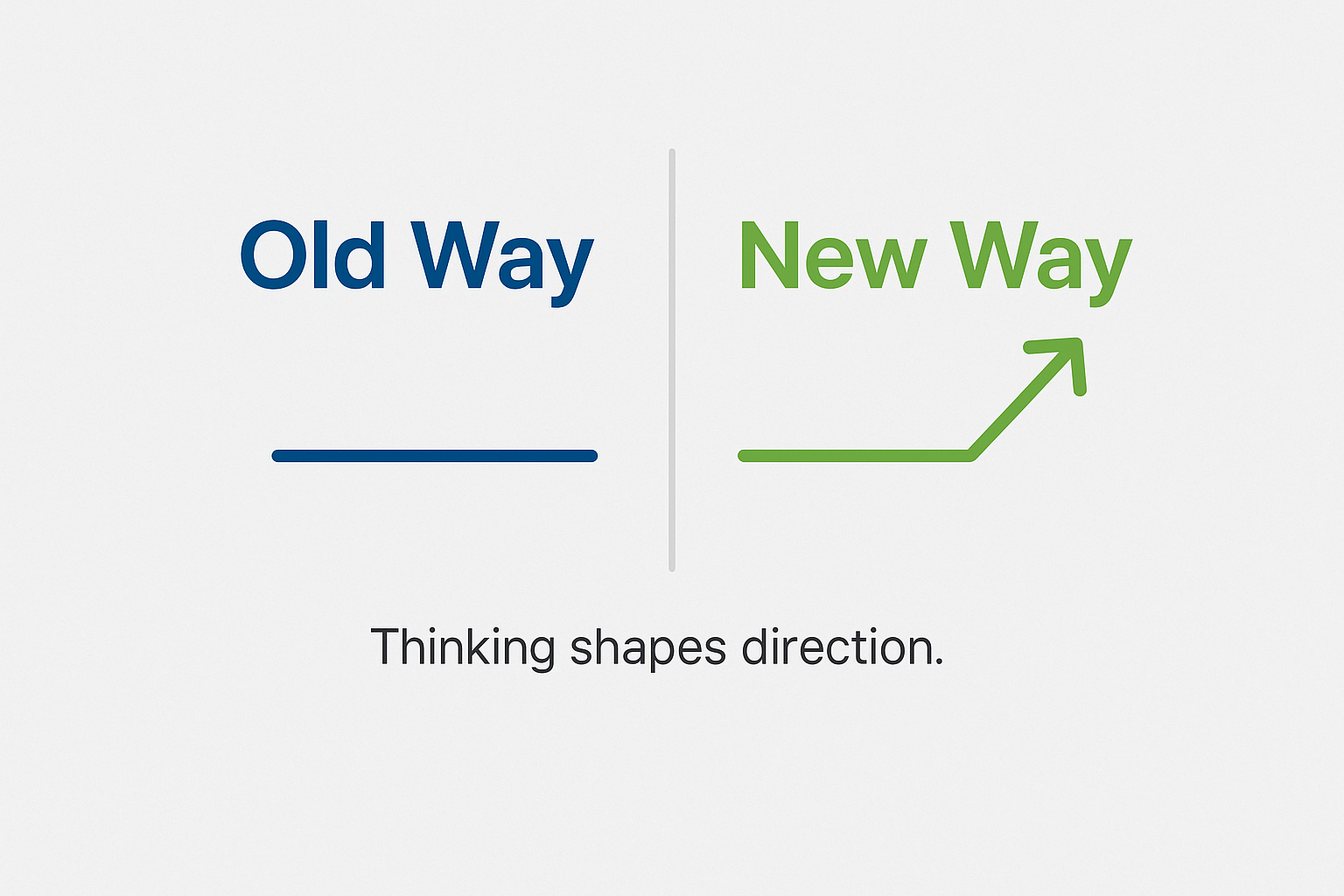
Comparison graphic showing old way versus new way with upward arrow

Can we think our way to results?
Both yes and no. Thinking alone doesn’t create change — but changing how you think while moving in the right direction absolutely can.

Our minds are incredibly powerful, yet often limited by our own patterns. When we open our thinking, we expand what’s possible and begin to notice opportunities we once thought were out of reach.

We’ve all heard the phrase “You can be anything you want.” I don’t fully agree. If we chase something that goes against our natural strengths, we might become competent — but rarely exceptional.

Real growth begins when you discover your strengths and build on your natural talents. As leadership expert John C. Maxwell writes, “The key choices you make — apart from the natural talent you already have — will set you apart from others who have talent alone.”
(From his book Talent Is Never Enough)

Success isn’t defined by talent alone — it’s shaped by your decisions, character, and mindset.

So start with your thinking. Expand it, align it, and act on it.
That’s when possibility becomes progress.

Want to better understand your natural strengths and how they influence the way you think, decide, and grow? Learn more about Core Color Personality Test.

Was this article helpful?
YesNo

Similar Posts

  • |

    What Lies Within

    When people hear the words personal development, they may wonder:

    “Does this mean I need to change who I am?”

    “Am I not already good enough?”

    Personal development does not mean becoming someone else. It does not mean rejecting who you are today or replacing your personality with a different one.

    I see it more like a sculptor working with clay.

    The clay already has substance, character, and potential. The sculptor does not replace it but carefully works with what is already there, gradually bringing its shape forward.

    That is how I see personal development: not creating a new person, but revealing more of the person who is already there.

    Bringing Forward What Is Already Within You

    We all have strengths, abilities, dreams, and qualities that may not yet be fully developed.

    Some may be hidden beneath fear, doubt, old habits, or past experiences. Others simply need attention, practice, and the right tools before they can grow.

    Personal development helps bring these qualities forward.

    It may involve reading, learning new skills, reflecting on our behaviour, or becoming more aware of how we think and respond. It may also involve understanding our personality—our natural strengths, our tendencies, and the patterns that sometimes hold us back.

    This does not mean becoming a different person.

    It means becoming a stronger, wiser, and more conscious version of yourself.

    Growth Still Requires Change

    Personal development does not mean that everything about us should remain exactly as it is.

    We may need to change habits that limit us. We may need to improve how we communicate, respond under pressure, treat other people, or lead ourselves through difficult situations.

    But changing a behaviour is not the same as rejecting who we are.

    Developing discipline—or building better habits, as I prefer to think of it—does not mean you had no value before. Becoming more patient, courageous, or thoughtful does not mean becoming someone else.

    It means continuing to shape what is already there.

    We Are Never Completely Finished

    A sculpture may eventually be considered complete. Human beings are different.

    There is always more we can learn about how we think, act, handle challenges, build relationships, and support the people around us.

    We can develop new skills and rediscover dreams that may have been buried beneath everyday responsibilities.

    Who we are today is not the limit of who we can become.

    Start by Understanding Yourself

    It is difficult to shape something we do not understand.

    Self-awareness gives us a clearer picture of our strengths, our personality, and the patterns that may be holding us back.

    A personality test cannot tell you who you must become. But it may help you understand more clearly who you already are—and where additional potential may be waiting to be developed.

    You are not a problem that needs to be fixed.

    You are a person who can continue to learn, grow, and bring forward more of what already exists within you.

    The clay is already there.

    The question is what you will choose to shape from it.

    Want to understand more about the strengths and natural tendencies you already carry? Explore the Core Color Personality Test.

    Related reading: Personal growth becomes easier when we understand both who we are and the habits that shape us. Read: Understand Yourself First and Are Your Habits Changing Your Life?

    Was this article helpful?
    YesNo
  • |

    Your Mental Diet Is Shaping Your Future

    Many of us think carefully about our physical health. We consider what we eat, how much we exercise, whether we are getting enough sleep, and what we can do to give our bodies the best possible conditions as we grow older.

    But how often do we think about our mental diet?

    Yes, you read that correctly: your mental diet.

    What are you feeding your mind every day, and how is it affecting the person you are becoming?

    Everything You Consume Leaves Something Behind

    During an ordinary day, information enters our minds from many different directions. We watch the news, scroll through social media, listen to conversations, read articles, watch videos, and perhaps read books or listen to audiobooks.

    Some of that content can give us knowledge, energy, inspiration, and direction. Other content can leave us feeling worried, frustrated, distracted, envious, or negative.

    I am not saying that we should avoid reality or ignore everything difficult. Life is not always positive, and we cannot control everything that happens around us. But we can become more aware of what we repeatedly choose to consume and what effect it has on us.

    After spending forty minutes scrolling through social media, it may be worth asking yourself: Do I feel better than I did before? Do I feel inspired to take action, or do I feel tired, irritated, dissatisfied, or discouraged?

    The answer may tell you something important about your mental diet.

    Social Media Shows a Picture, Not the Whole Story

    Social media can affect us through conflict, complaints, and negative stories. But it can also affect us through comparison.

    We may see someone’s home, relationship, holiday, success, or lifestyle and begin asking why our own life does not look the same. Their life appears happy, effortless, and complete, while ours may feel ordinary or difficult by comparison.

    But social media rarely shows the whole picture. It shows selected moments, carefully chosen images, and often only the parts someone wants other people to see. Behind the photograph, reality may look very different.

    When we compare our entire life with someone else’s best moments, we may create feelings of envy, inadequacy, or dissatisfaction based on a picture that was never complete in the first place.

    At the same time, looking at someone who has achieved something you genuinely want is not necessarily envy. It can become inspiration.

    Perhaps you follow someone who travels frequently, has built a successful business, developed a skill you admire, or created part of the life you would like to build. If what you see encourages you to take action towards your own dreams, then it may strengthen rather than diminish you.

    The difference is often found in the feeling and response it creates. Does it make you think, “Why do they have that and not me?” Or does it make you think, “If it is possible for them, perhaps I can begin moving towards it too?”

    We need to remain open to inspiration while also being critical of the images and stories we accept as the full truth.

    Your Feed Learns From Your Choices

    I have noticed that social media often gives us more of what we already choose to watch.

    If we repeatedly stop for conflict, fear, complaints, or outrage, more of that type of content may gradually appear. But if we actively search for material that educates, challenges, motivates, or inspires us, our feed can begin to change in the opposite direction.

    In my own feed, I now often see clips from people such as Jim Rohn and other material connected to personal development, growth, and success. That is still social media, but it does not affect me in the same way as aimless scrolling through negativity.

    It gives me ideas, reminders, and new ways of thinking.

    In that sense, we are not only consuming our feeds. We are also helping to shape them. Every click, pause, search, and choice teaches the platform what to place in front of us next.

    That makes our choices even more important.

    What I Have Noticed in Myself

    I have been aware of personal development for many years. But knowing something does not mean that we always practise it consistently.

    We are human, and sometimes we fall back into old habits.

    During the six weeks before writing this blog, I became much more intentional about my own mental diet. Each day, I spent approximately ninety minutes developing myself. Around sixty minutes were spent reading, while the remaining thirty minutes were used to study material that I believe I need in order to change my thinking and move closer to my goals.

    During my walks, I also listened to audiobooks and other material connected to the direction in which I want to take my life. This included books such as The Magic of Thinking Big and Psycho-Cybernetics, alongside other personal-development and business material.

    At the same time, I spent much less time watching the news and much less time scrolling without a purpose.

    The difference I have noticed in myself has been significant. I feel more focused, more positive, and more connected to what I want to achieve. I no longer feel the same need to sit and watch the news. When I use social media, much of what appears is now connected to growth, success, and the subjects I want more of in my life.

    I have not become perfect, and I still sometimes fall back into old patterns. But that is also part of being human.

    The important thing is to notice it and consciously choose what we want to begin feeding our minds again.

    Where Is Your Mental Diet Taking You?

    A single video, post, or news story may not change your life. But repeated inputs can gradually influence how you think, feel, and respond to the world around you.

    They may affect your mood at work, how patiently you treat your family or partner, how you see your future, and whether you mainly notice opportunities or problems.

    The question is therefore not only how something makes you feel today. It is also where that repeated influence may take you in two years or five years.

    Is what you consume helping you become more focused, hopeful, disciplined, and connected to your goals? Or is it slowly moving you in the opposite direction?

    We cannot control everything that enters our lives. But we can take greater responsibility for what we repeatedly choose to place inside our minds.

    For one month, try becoming more intentional about your mental diet. Notice what gives you energy and what drains it. Choose books, audiobooks, podcasts, courses, and people who help you grow. Reduce some of the content that repeatedly leaves you feeling worse without giving you anything useful in return.

    Then observe what changes in your thoughts, energy, relationships, work, and direction.

    We often ask ourselves what we have eaten today.

    Perhaps we should also ask:

    What have I fed my mind?


    Do your emotional patterns influence what you focus on and how strongly outside information affects you? Explore the Emotional Style Test.

    Are your daily choices moving you towards the future you want? Explore the Goal Style Test.

    Was this article helpful?
    YesNo

  • |

    Does It Inspire You—or Make You Feel Behind?

    Sometimes we see someone else’s home, holiday, business, or lifestyle and begin wondering why our own life does not look like that.

    Their life appears happy and complete. Our own may feel ordinary by comparison.

    But what are we actually comparing?

    Social media shows selected moments. We see the photographs and the parts someone chooses to share. We do not necessarily see what life looks like outside those moments.

    When we compare our entire life with someone else’s best moments, we can begin feeling dissatisfied with our own situation based on a picture that was never complete.

    I think that is something we need to remember when we look at other people’s lives. The image may show something real, but it does not show everything.

    At the same time, looking at someone who has achieved something we want is not necessarily a bad thing.

    Perhaps they have built a business, developed a skill, or created the opportunity to travel more. Perhaps something about their life helps us see a possibility for our own.

    That can become inspiration.

    The difference is often in the feeling it creates and what we do afterward. Do I look at it and think, “Why do they have that and not me?” Or do I think, “If it is possible for them, perhaps I can begin moving towards it too?”

    Those thoughts can take us in different directions.

    I do not think we need to stop looking at what others are doing. But I think it helps to notice how it affects us.

    After spending time scrolling, do I feel inspired to take action? Have I seen something useful? Or do I mainly feel dissatisfied with my own life?

    For me, material connected to personal development and growth can give me ideas, reminders, and new ways of thinking. That is very different from scrolling and finishing with a feeling that my own life is not enough.

    We can be open to inspiration and still question the picture we are seeing.

    If something encourages us to work toward our own dreams, it may be valuable. But if we keep comparing our whole life with a few selected moments from someone else’s, it is worth noticing what that comparison is doing to us.

    Related reading: The things we repeatedly watch, read, and listen to can influence how we see our own lives. Read: Your Mental Diet Is Shaping Your Future

    Was this article helpful?
    YesNo
  • |

    It Starts With You

    It is easy to say that we want something different.
    A better career. Better health. More freedom. A stronger business. Personal growth. Whatever success means to us.
    But there is another question that may be more important:
    Are we willing to become the person who can create that result?
    Because wanting something and being willing to do what it requires are not always the same thing.

    When Comfortable Starts to Feel Like Progress

    Sometimes we find something we are good at.
    We understand it. We feel comfortable doing it. Other people recognise us for it. Maybe they ask for our advice, appreciate what we do or even begin to see us as an expert.
    There is absolutely nothing wrong with that.
    But it can also become a very comfortable place to stay.
    Especially when recognition becomes part of the reward.
    When people notice us, appreciate us and make us feel important, it is easy to think:
    This must be where I should focus.
    Maybe it is.

    But there is another question worth asking:

    Is this actually taking me where I say I want to go?
    Those two things are not always the same.
    Something can make us feel successful today without necessarily moving us toward the future we say we want.

    Be Honest About What Is Holding You Back

    This is where being honest with ourselves becomes difficult.
    Sometimes the things we avoid are exactly the things we need to work on.
    Maybe we avoid situations where we might be rejected.
    Maybe we avoid conversations that make us uncomfortable.
    Maybe we stay with the things we already know because starting again would make us feel like a beginner.
    Maybe we enjoy being in an environment where we feel confident and respected, while quietly avoiding another area where we know we need to grow.
    It is much easier to continue doing something that makes us feel good than to look at the parts of ourselves that may be holding us back.
    I know this because I have done it myself.
    There are things I am comfortable doing and things that require much more from me. There are days when I would much rather stay with what I already know than push myself into something uncomfortable.

    But if the uncomfortable part is standing between me and where I want to go, avoiding it does not make it disappear.

    Does Your Goal Match Your Actions?

    There is nothing wrong with changing your goal.
    Maybe what you wanted five years ago is no longer important to you. Maybe your definition of success has changed.
    That is perfectly okay.
    Success does not have to mean money, status or building something huge. For one person it may mean freedom. For another it may mean family, health, contribution, peace of mind or simply having more control over their time.
    But whatever your goal is, I believe we owe it to ourselves to be honest about it.
    If I say I want one result while deliberately avoiding the actions required to create it, there is a gap between what I say and what I do.
    I cannot keep saying I want the destination while refusing to travel the road that leads there.
    At some point I have to make a choice.
    Either change the goal.
    Or start working on the things that are keeping me from it.

    No One Else Can Do That Work for You

    A mentor can help you.
    A leader can guide you.
    A coach can challenge you, teach you and sometimes see things in you that you cannot yet see yourself.
    But they cannot do the work for you.
    And if you are not willing to invest in your own development, why should you expect somebody else to invest more in your future than you do?
    That does not mean you have to have everything figured out.
    It does not mean you cannot be afraid.
    It does not mean you will always feel motivated.
    It simply means being willing to work on yourself — especially the parts that are easier to avoid.
    Because sometimes the biggest obstacle between where we are and where we want to be is not a lack of opportunity.
    It is something within ourselves that we have not been willing to face yet.
    And that is where real growth starts.
    It starts with you.

    Related reading: The Hidden Danger of the Comfort Zone

    Was this article helpful?
    YesNo
  • | |

    Navigation

    Most of us understand the importance of having goals. We want to know where we are going, what we want to achieve, and perhaps even what kind of person we want to become along the way. But knowing your destination is not the same as knowing how to get there. You also need to know how to navigate.

    Setting a Course Is Only the Beginning

    Imagine a ship leaving one port and heading toward another. The destination is clear. The course has been calculated. Everyone knows where the ship is supposed to go. But that does not mean the ship can simply point toward the destination and continue without adjustment.

    There is wind. There are currents. Weather changes. Other vessels may appear. Conditions change along the way. The ship constantly needs small course corrections. Life is not very different.

    We can set a goal and have a clear idea of what we want. But once we start moving, things happen. We learn new things. Circumstances change. We make mistakes. Opportunities appear that we did not expect.

    There is a saying I have always liked: Put your goals in concrete and your plans in sand.

    Your destination can remain firm while the route toward it stays flexible. Changing the plan does not necessarily mean changing the goal. Sometimes adapting the route is exactly what allows you to reach it. That is what navigation is about.

    You Can Be Moving and Still Be Off Course

    There is an important difference between movement and progress. You can work hard every day. You can be disciplined. You can keep pushing forward.

    But if your course is slightly wrong, the distance between where you intended to go and where you actually end up can become surprisingly large over time. That does not mean constantly changing your goals.

    It means occasionally stopping and asking: Am I still heading in the right direction?

    Sometimes the answer will be yes. Sometimes you only need a small correction. And sometimes you may realize that the route needs to change completely.

    When You Cannot See the Way Ahead

    I learned something about navigation very literally many years ago when I worked at sea. I had worked my way up on deck, and part of my job eventually involved steering the ship.

    The first times I stood behind the wheel, we practiced out at sea. A large ship does not react like a car. When you begin a turn, you also have to understand when to counter the movement so the vessel settles on the correct course. An officer stood beside me and told me exactly what to do.

    Later came something much more challenging: steering while entering a harbor. Now there were passengers on board, people eating and drinking, and everything had to be done smoothly. A badly handled turn could affect far more than their comfort. In some places there was shallow water outside the safe channel, so staying on course really mattered.

    One experience has stayed with me in particular. We were approaching a harbor in very dense fog. I could barely see anything ahead of me.

    We knew exactly which harbor we were going to. We knew where the entrance was. We knew the course. But from where I was standing, I could not see the way.

    So I had to rely on the instruments in front of me and on the officer giving me instructions. A few degrees one way. A correction. Then another instruction. I concentrated on the course and followed what I was being told.

    And then, through the fog, the lights at the harbor entrance appeared on either side of the ship. We were exactly where we needed to be.

    That experience has become a powerful picture for me of how navigation works in life. Sometimes you know where you are going even when you cannot see the way there.

    The Value of Another Perspective

    This is also where another person can become incredibly valuable. You can certainly choose to navigate toward your goals and dreams completely on your own. But that often makes the journey harder and more uncertain than it needs to be.

    A mentor can give you something that is difficult to give yourself: perspective.

    Preferably, that mentor is someone who has already done what you are trying to do or has travelled a similar road. They know some of the currents. They recognize some of the obstacles. They may see that you are drifting long before you notice it yourself.

    A good mentor does not take control of your life. They do not do the work for you. You still have to steer. But they can help you recognize when a course correction is needed.

    Just as the officer on the bridge could see and understand things that I could not yet see for myself, someone with greater experience can sometimes give us a perspective we simply do not have yet.

    Navigation Requires Confidence and Humility

    I believe we should trust ourselves. We should believe that we are capable of learning, growing, and accomplishing things that may initially seem difficult.

    But believing in yourself does not mean believing that you must know everything yourself. There is strength in being able to say: This is where I want to go. I am willing to do the work. But I am also willing to learn from someone who has travelled this way before me.

    The goal is not to prove that you can travel alone. The goal is to reach the destination.

    Keep Your Hands on the Wheel

    Whatever you are working toward right now, perhaps the most important question is not simply: Where do I want to go?

    Also ask: How am I navigating? What are you using as your instruments? How often are you checking your course? Who can give you a perspective that you cannot see from where you are standing? And when you discover that you have moved slightly off course, are you willing to make the correction?

    You may not always be able to see the entire journey ahead. Sometimes there will be fog.

    But if you know your destination, stay adaptable in how you get there, pay attention to your instruments, listen to experienced guidance, and make the necessary course corrections, you can keep moving in the right direction.

    And eventually, the lights you have been navigating toward may begin to appear through the fog.

    Related reading: Reaching your destination also requires being honest about whether your actions are taking you there. Read: It Starts With You.

    Was this article helpful?
    YesNo

  • |

    Your Vision Is Yours

    Not everyone will understand your vision.

    Not everyone will support it. And not everyone who says they are interested will actually take the time to understand what you are trying to build.

    I have experienced this myself with Equipido.

    I have shown it to people who are interested in personal development. I have given them the opportunity to try it, explore it and even receive a detailed report without paying for it.

    Some said they were interested.

    But they never did it.

    At first, that can be frustrating. You start wondering why they cannot see what you see.

    But then I realised something important:

    It is my vision, not theirs.

    I cannot expect another person to feel the same excitement about something that I have spent months or years thinking about, building and believing in.

    Their lack of interest does not mean the idea is wrong.

    And their lack of action does not mean I should stop.

    They Do Not Need to See What You See

    When you have an idea, a goal or something you want to build, it is natural to want support from the people around you.

    But sometimes we put too much weight on their reaction.

    Someone may not understand why you want to change career, start a business or spend evenings and weekends working toward something that does not exist yet.

    That is okay.

    They are looking at your vision through their own experiences, priorities and beliefs.

    You are looking at it through yours.

    Your vision does not become less valuable because someone else cannot see it.

    Sometimes the Lesson Is the Result

    Around 15 or 20 years ago, I had an idea to build an online community for Christians — something similar to a social network.

    I believed in the idea even though very few people around me did.

    This was long before AI made it possible to build things the way we can today, so I had to pay people to help me develop it. I invested a significant amount of money in the project.

    It never became what I had imagined.

    But I do not look at that money as wasted.

    The project taught me something important about myself.

    I realised that I was very good at coming up with ideas and creating things, but at that time I was not equally good at driving them forward and turning them into something sustainable.

    That was an important lesson.

    People spend money on education all the time. In many ways, that project was part of my education.

    Sometimes the return on an idea is not the business you hoped to build. Sometimes it is what the experience teaches you about yourself.

    You Still Have to Try

    Believing in something does not guarantee that it will work.

    You may try and fail.

    You may discover that part of your idea was wrong. You may have to change direction, learn something new or start again.

    But that is very different from never trying because someone else did not believe in it.

    If you try and it does not work, learn from it.

    If something needs to change, change it.

    Then keep moving.

    Because even if you fail, you have still done something many people never do.

    You tried.

    Sometimes the first person who needs to believe in your vision is simply you.

    Related reading: When you build something you believe in, fear and doubt often come with it. Read: Fear and Doubt Are Part of Growth

    Was this article helpful?
    YesNo