·

The Need for Acceptance

Calm ripples spreading across the water from a small stone, symbolizing how the need for acceptance and criticism can create inner emotional reactions.

Many people seek acceptance.

We want to feel that what we do matters, that our ideas are respected, and that we are understood by others.

In many ways, this is completely natural.

But the need for acceptance can sometimes influence us more than we realize.

When we receive criticism — or even something that we interpret as criticism — it can affect our emotional state.

Sometimes more than it should.

A simple email, message, or comment can trigger a reaction.

Even when we rationally understand that people communicate differently and may not intend anything negative, emotions can still respond first.

I can recognize that in myself.

Sometimes a comment or message can stay in my thoughts longer than I would like.

Even when I know logically that it shouldn’t.

That’s something I actively work on.

Part of personal growth is learning to recognize our own triggers.

Why do certain things affect us more than others?

What experiences or expectations are behind those reactions?

Different people react differently to the same situation.

If ten people experience the same event, you will probably see ten different reactions.

Our backgrounds, personalities, and experiences shape how we interpret the world.

That’s why there is rarely a universal “right” way to react.

The important part is learning to understand ourselves better over time.

Because when we begin to understand our own reactions, we also begin to reduce the power they have over our decisions.

And that’s where real growth begins.

Want to understand why feedback or criticism affects you the way it does—and how your response patterns influence your growth? Learn more about the Feedback Style Test.

Was this article helpful?
YesNo

Similar Posts

  • The Hidden Danger of the Comfort Zone

    Comfort zones feel safe.

    They are familiar. Predictable. Controlled.

    But comfort zones can also quietly become one of the biggest obstacles to personal growth.

    When we stay in what feels comfortable, we rarely challenge ourselves. We repeat the same patterns, make the same decisions, and surround ourselves with the same environments.

    Nothing feels difficult — but nothing truly changes either.

    Growth almost always requires stepping into situations that feel unfamiliar or uncomfortable.

    That might mean speaking in front of people, sharing your ideas publicly, starting something new, or putting yourself in situations where you know others might disagree with you.

    Those moments can feel uncomfortable because they remove the protection of certainty.

    But discomfort is often a signal that something important is happening.

    It means we are stretching beyond our current limits.

    The comfort zone is not dangerous because it feels bad.

    It’s dangerous because it feels good enough to keep us there.

    And if we stay there too long, we slowly stop moving forward.

    Related reading: Fear and doubt often appear when we step outside our comfort zone. Read: Fear and Doubt Are Part of Growth

    Want to understand how your decision patterns influence whether you stay with what feels safe or move toward change? Learn more about the Decision Style Test.

    Was this article helpful?
    YesNo
  • |

    Be the Bridge

    Sometimes something feels easy when we do it as part of a job, but much harder when we do it for ourselves. At work, we may have no problem calling someone, sending an email, starting a conversation, or presenting an idea. We are representing a company or completing a task. But when we begin building something of our own, the same actions can suddenly feel personal.

    The phone feels heavier. We hesitate before sending the message. We begin wondering what the other person will think, how they will respond, and what their answer might say about us. A simple no can begin to feel like personal rejection. But perhaps there is another way to see it.

    Imagine a Backpack

    Imagine placing everything you have to offer inside a backpack. It could be a product, a service, an opportunity, an idea, knowledge, experience, or something else that can create genuine value for another person. You put the backpack on and carry it with you.

    When you contact someone, you are not asking them to approve of you. You are simply giving them the opportunity to look at what you carry. You are the messenger. You are also the bridge between the person and what is inside your backpack.

    Your responsibility is to build that bridge and make the offer honestly. Their responsibility is to choose.

    A No Is Not Always About You

    Think about how people choose grocery stores. Some people regularly shop at one store and would never choose another. Someone else may make the opposite choice. That does not mean either store has no value. People make different choices based on their preferences, needs, experiences, priorities, and current circumstances.

    It will be the same with what you carry. Some people will say yes. Some people will say no. Some people may say not now.

    Some will, some won’t—so what?

    Their answer does not automatically define the value of what you offer. More importantly, it does not define your value as a person.

    There is a saying I have learned through the business I do:

    “We are looking for the people who are looking for us.”

    That does not mean sitting still and waiting for those people to appear. We still need to reach out. We still need to start conversations and build bridges. But we do not need everyone to choose what we carry.

    Know the Value of What You Carry

    This way of thinking also comes with responsibility. Your backpack should contain something you genuinely believe can create real value for the people you approach.

    If you know that what you offer cannot help them, then confidence is not what you are building. You are simply creating false expectations.

    Before becoming proud of what you carry, make sure it is worthy of that pride. Understand what you offer, why it matters, and how it may help someone.

    When you are secure in that knowledge, reaching out can begin to feel different. You are not trying to mislead anyone or force them into a decision. You are offering them the opportunity to look at something you honestly believe may have value. They are still free to choose.

    Putting on the Backpack

    The backpack is not only an image. It can become a mental tool. Before making a call, sending a message, or starting a conversation, pause for a moment. Imagine putting on the backpack. Remind yourself that you are carrying something you believe in. Then remind yourself of your role:

    You are not responsible for making the other person say yes. You are not responsible for their timing, priorities, previous experiences, or personal preferences. You are responsible for taking the step, building the bridge, and giving them the opportunity to look.

    This can help create some distance between your identity and their answer. A no may still feel disappointing. But it does not need to become a judgment about who you are.

    Self-Leadership Through Action

    Some people find it easy to approach others without overthinking. For others, it requires courage. Neither person should be judged. We all carry different experiences, fears, strengths, and beliefs about ourselves.

    Self-leadership is not always about feeling confident before we act. Sometimes it means learning to guide ourselves through uncertainty and act even when confidence is not yet there.

    The more often you take the step, the more natural it can become. You begin learning that you can handle a no. You begin separating other people’s choices from your own value. You begin building confidence through action.

    The next time you feel uncertain about contacting someone, picture the backpack. Remember what you carry. Remember why you believe it has value. Put the backpack on, build the bridge, and take the next step.

    Your responsibility is to offer. Their responsibility is to choose.


    Related reading: Our fear of rejection is often connected to our need to feel accepted and understood. Read The Need for Acceptance.

    Do your emotions sometimes influence whether you take action or hold yourself back? Explore the Emotional Style Test.

    Want to understand how you lead yourself when something feels uncomfortable or uncertain? Explore the Leadership Style Test.

    Was this article helpful?
    YesNo
  • |

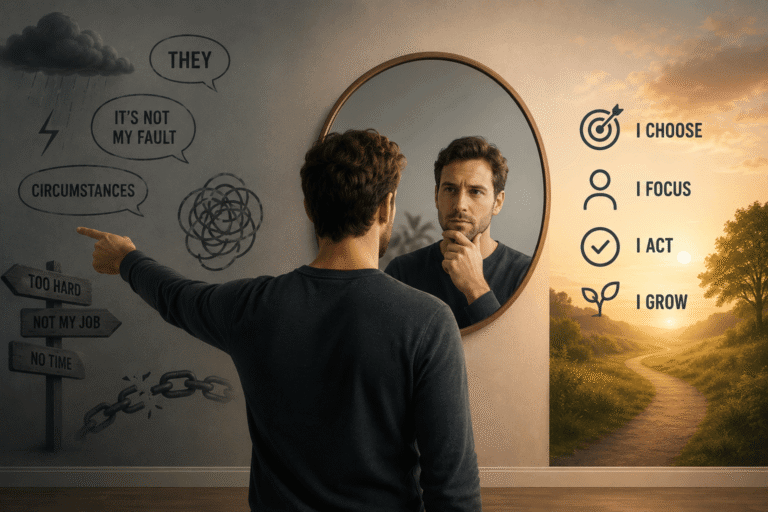
    The Blame Game


    When something does not go our way, it is often easy to find someone or something else to blame.

    It was because of my boss. My partner made it difficult. Everyone else does the same thing. I did not have the right opportunity. The circumstances were against me.

    Sometimes those things may even be true. There are circumstances in life that we cannot control, and there are things that happen to us that are genuinely not our fault.

    But there is a danger when blaming others becomes our normal response. Because the moment everything becomes someone else’s fault, we also remove responsibility from ourselves. And if we have no responsibility, we have no reason to take action.

    That is where the blame game can begin to hold us back.

    What Can You Actually Control?

    I am not saying that everything that happens in our lives is our fault. It is not.

    There are things we cannot control. Other people make decisions that affect us. Companies change. Relationships end. We may experience difficult circumstances, illness, loss, or things from our past that we never chose.

    But even when we cannot control what happens, we often still have some control over what we do next. That distinction is important.

    Instead of asking only, “Whose fault is this?” perhaps a more useful question is:

    What can I do about it now?

    That question brings responsibility back to us. And with responsibility comes the possibility of change.

    The Everyday Blame Game

    The blame game does not always appear in major life situations. Often it shows up in very ordinary things.

    Imagine that I want to lose weight, but my partner regularly brings home chips, sweets, and other things I am trying not to eat.

    I could say: “If my partner did not buy those things, I would not gain weight.”

    And yes, perhaps it would be easier if my partner supported my goal and did not bring those things home. But my partner is still not the person putting the food in my mouth. That choice is mine.

    Or perhaps I am unhappy with how much I earn.

    “My employer will not pay me more.”

    That may be completely true. Maybe the company cannot afford to pay more. Maybe they do not believe my current performance justifies a higher salary. Maybe there are other reasons.

    But what can I do?

    I can ask what I need to improve. I can develop new skills. I can become better at what I do. I can look for another position. I can find another way to increase my income.

    I may not be able to control what my employer decides. But I can control what I decide to do next.

    The same applies to something as simple as arriving late to work.

    “But everyone else comes late.”

    Maybe they do. But everyone else is not responsible for when I arrive. I am.

    Responsibility Gives You Options

    This is why I believe the blame game can be so damaging when we want to change our lives. Not physically damaging, perhaps, but damaging to our growth.

    If I constantly believe that other people are responsible for where I am, then I also give those people control over whether my life can change.

    I want more freedom, but someone else is stopping me. I want better health, but someone else makes it difficult. I want a better career, but my employer will not give me the opportunity. I want to fulfil my dreams, but my circumstances are wrong.

    If everything depends on someone else changing first, I may wait for a very long time.

    But when I begin asking what I can change, something happens. I get options again.

    Not always easy options. Not always quick ones. But options.

    What Are Your Mistakes Teaching You?

    Blaming others can also prevent us from learning from our mistakes.

    John C. Maxwell wrote a book called Failing Forward, built around the idea that failure and mistakes can become part of our growth when we learn from them.

    I believe there is a lot of truth in that.

    We are going to make mistakes. I have made many, and I will make more. But if every mistake immediately becomes somebody else’s fault, what am I supposed to learn from it?

    If I say, “It happened because of them,” I can walk away without examining my own decisions.

    If instead I ask, “What could I have done differently?” I may discover something that helps me the next time.

    That does not mean taking responsibility for things that genuinely belonged to someone else. It means being willing to look honestly at the part that belonged to me.

    Sometimes the Blame Goes Back Years

    The blame game can also reach much further back. We can blame our childhood, our parents, previous relationships, lost opportunities, or things that happened many years ago.

    This is something I can relate to personally.

    I had a difficult childhood, and of course experiences from those years affected me. I cannot pretend they did not.

    But at some point I had to ask myself another question:

    Why should I allow what happened then to decide the rest of my life?

    I cannot change what happened. I cannot go backwards and create another childhood. But I can decide what I want to do with my life from here.

    The past may explain some of the way we think, react, or behave today. Understanding that can be important. But explanation does not have to become a life sentence.

    At some point, if I want something different, I have to begin taking responsibility for building something different.

    That is part of the inner journey.

    Change What You Can Change

    Sometimes we make change much more complicated than it needs to be.

    I do not have enough money. What can I change?

    I am unhappy with my health. What can I change?

    I do not like where my career is going. What can I change?

    I keep ending up in the same situation. What can I change?

    Notice that I am asking what, not how. Many people get stuck at “How am I going to do this?” and immediately see everything they do not have or cannot do. First become clear about why you want the change and what you want to change. When your why and your what are clear, the how often becomes easier to see.

    The answer may not be immediate, and the solution may require time, effort, learning, difficult conversations, or uncomfortable decisions.

    But blaming someone else rarely moves us forward.

    A fast-food restaurant is not responsible for the fact that I stopped there when I was hungry. The restaurant can be directly on my way home, with a huge sign in front of me, but I am still the one who turns the car into the parking lot.

    That does not mean every choice is easy. It means it is still a choice.

    Step Out of the Blame Game

    Perhaps one of the most useful things we can do is become aware of how often we blame circumstances or other people.

    Not so that we can start blaming ourselves instead. That is not the point.

    The point is to recognise where our own responsibility begins.

    When something goes wrong, we can ask:

    What part of this could I control?
    What could I have done differently?
    What can I learn from it?
    What can I do now?

    There will always be things outside our control. But we do not need to give those things control over everything that happens next.

    Taking responsibility does not change the past.

    It changes what we are able to do with the future.


    Related reading: Growth often requires us to look at our own patterns before looking at everyone around us. Read Understand Yourself First.

    Do you tend to act quickly, avoid decisions, or look outside yourself when choices become difficult? Explore the Decision Style Test.

    How do you respond when things go wrong or emotions become difficult? Explore the Emotion Style Test.

    Was this article helpful?
    YesNo
  • |

    Your Mental Diet Is Shaping Your Future

    Many of us think carefully about our physical health. We consider what we eat, how much we exercise, whether we are getting enough sleep, and what we can do to give our bodies the best possible conditions as we grow older.

    But how often do we think about our mental diet?

    Yes, you read that correctly: your mental diet.

    What are you feeding your mind every day, and how is it affecting the person you are becoming?

    Everything You Consume Leaves Something Behind

    During an ordinary day, information enters our minds from many different directions. We watch the news, scroll through social media, listen to conversations, read articles, watch videos, and perhaps read books or listen to audiobooks.

    Some of that content can give us knowledge, energy, inspiration, and direction. Other content can leave us feeling worried, frustrated, distracted, envious, or negative.

    I am not saying that we should avoid reality or ignore everything difficult. Life is not always positive, and we cannot control everything that happens around us. But we can become more aware of what we repeatedly choose to consume and what effect it has on us.

    After spending forty minutes scrolling through social media, it may be worth asking yourself: Do I feel better than I did before? Do I feel inspired to take action, or do I feel tired, irritated, dissatisfied, or discouraged?

    The answer may tell you something important about your mental diet.

    Social Media Shows a Picture, Not the Whole Story

    Social media can affect us through conflict, complaints, and negative stories. But it can also affect us through comparison.

    We may see someone’s home, relationship, holiday, success, or lifestyle and begin asking why our own life does not look the same. Their life appears happy, effortless, and complete, while ours may feel ordinary or difficult by comparison.

    But social media rarely shows the whole picture. It shows selected moments, carefully chosen images, and often only the parts someone wants other people to see. Behind the photograph, reality may look very different.

    When we compare our entire life with someone else’s best moments, we may create feelings of envy, inadequacy, or dissatisfaction based on a picture that was never complete in the first place.

    At the same time, looking at someone who has achieved something you genuinely want is not necessarily envy. It can become inspiration.

    Perhaps you follow someone who travels frequently, has built a successful business, developed a skill you admire, or created part of the life you would like to build. If what you see encourages you to take action towards your own dreams, then it may strengthen rather than diminish you.

    The difference is often found in the feeling and response it creates. Does it make you think, “Why do they have that and not me?” Or does it make you think, “If it is possible for them, perhaps I can begin moving towards it too?”

    We need to remain open to inspiration while also being critical of the images and stories we accept as the full truth.

    Your Feed Learns From Your Choices

    I have noticed that social media often gives us more of what we already choose to watch.

    If we repeatedly stop for conflict, fear, complaints, or outrage, more of that type of content may gradually appear. But if we actively search for material that educates, challenges, motivates, or inspires us, our feed can begin to change in the opposite direction.

    In my own feed, I now often see clips from people such as Jim Rohn and other material connected to personal development, growth, and success. That is still social media, but it does not affect me in the same way as aimless scrolling through negativity.

    It gives me ideas, reminders, and new ways of thinking.

    In that sense, we are not only consuming our feeds. We are also helping to shape them. Every click, pause, search, and choice teaches the platform what to place in front of us next.

    That makes our choices even more important.

    What I Have Noticed in Myself

    I have been aware of personal development for many years. But knowing something does not mean that we always practise it consistently.

    We are human, and sometimes we fall back into old habits.

    During the six weeks before writing this blog, I became much more intentional about my own mental diet. Each day, I spent approximately ninety minutes developing myself. Around sixty minutes were spent reading, while the remaining thirty minutes were used to study material that I believe I need in order to change my thinking and move closer to my goals.

    During my walks, I also listened to audiobooks and other material connected to the direction in which I want to take my life. This included books such as The Magic of Thinking Big and Psycho-Cybernetics, alongside other personal-development and business material.

    At the same time, I spent much less time watching the news and much less time scrolling without a purpose.

    The difference I have noticed in myself has been significant. I feel more focused, more positive, and more connected to what I want to achieve. I no longer feel the same need to sit and watch the news. When I use social media, much of what appears is now connected to growth, success, and the subjects I want more of in my life.

    I have not become perfect, and I still sometimes fall back into old patterns. But that is also part of being human.

    The important thing is to notice it and consciously choose what we want to begin feeding our minds again.

    Where Is Your Mental Diet Taking You?

    A single video, post, or news story may not change your life. But repeated inputs can gradually influence how you think, feel, and respond to the world around you.

    They may affect your mood at work, how patiently you treat your family or partner, how you see your future, and whether you mainly notice opportunities or problems.

    The question is therefore not only how something makes you feel today. It is also where that repeated influence may take you in two years or five years.

    Is what you consume helping you become more focused, hopeful, disciplined, and connected to your goals? Or is it slowly moving you in the opposite direction?

    We cannot control everything that enters our lives. But we can take greater responsibility for what we repeatedly choose to place inside our minds.

    For one month, try becoming more intentional about your mental diet. Notice what gives you energy and what drains it. Choose books, audiobooks, podcasts, courses, and people who help you grow. Reduce some of the content that repeatedly leaves you feeling worse without giving you anything useful in return.

    Then observe what changes in your thoughts, energy, relationships, work, and direction.

    We often ask ourselves what we have eaten today.

    Perhaps we should also ask:

    What have I fed my mind?


    Do your emotional patterns influence what you focus on and how strongly outside information affects you? Explore the Emotional Style Test.

    Are your daily choices moving you towards the future you want? Explore the Goal Style Test.

    Was this article helpful?
    YesNo

  • |

    What Lies Within

    When people hear the words personal development, they may wonder:

    “Does this mean I need to change who I am?”

    “Am I not already good enough?”

    Personal development does not mean becoming someone else. It does not mean rejecting who you are today or replacing your personality with a different one.

    I see it more like a sculptor working with clay.

    The clay already has substance, character, and potential. The sculptor does not replace it but carefully works with what is already there, gradually bringing its shape forward.

    That is how I see personal development: not creating a new person, but revealing more of the person who is already there.

    Bringing Forward What Is Already Within You

    We all have strengths, abilities, dreams, and qualities that may not yet be fully developed.

    Some may be hidden beneath fear, doubt, old habits, or past experiences. Others simply need attention, practice, and the right tools before they can grow.

    Personal development helps bring these qualities forward.

    It may involve reading, learning new skills, reflecting on our behaviour, or becoming more aware of how we think and respond. It may also involve understanding our personality—our natural strengths, our tendencies, and the patterns that sometimes hold us back.

    This does not mean becoming a different person.

    It means becoming a stronger, wiser, and more conscious version of yourself.

    Growth Still Requires Change

    Personal development does not mean that everything about us should remain exactly as it is.

    We may need to change habits that limit us. We may need to improve how we communicate, respond under pressure, treat other people, or lead ourselves through difficult situations.

    But changing a behaviour is not the same as rejecting who we are.

    Developing discipline—or building better habits, as I prefer to think of it—does not mean you had no value before. Becoming more patient, courageous, or thoughtful does not mean becoming someone else.

    It means continuing to shape what is already there.

    We Are Never Completely Finished

    A sculpture may eventually be considered complete. Human beings are different.

    There is always more we can learn about how we think, act, handle challenges, build relationships, and support the people around us.

    We can develop new skills and rediscover dreams that may have been buried beneath everyday responsibilities.

    Who we are today is not the limit of who we can become.

    Start by Understanding Yourself

    It is difficult to shape something we do not understand.

    Self-awareness gives us a clearer picture of our strengths, our personality, and the patterns that may be holding us back.

    A personality test cannot tell you who you must become. But it may help you understand more clearly who you already are—and where additional potential may be waiting to be developed.

    You are not a problem that needs to be fixed.

    You are a person who can continue to learn, grow, and bring forward more of what already exists within you.

    The clay is already there.

    The question is what you will choose to shape from it.

    Want to understand more about the strengths and natural tendencies you already carry? Explore the Core Color Personality Test.

    Related reading: Personal growth becomes easier when we understand both who we are and the habits that shape us. Read: Understand Yourself First and Are Your Habits Changing Your Life?

    Was this article helpful?
    YesNo
  • The Courage to Be Visible

    Building a website is one thing.

    Putting your thoughts online is another.

    But showing yourself — your face, your voice, your personality — on video is a completely different level of exposure.

    When you see yourself on camera, it’s very easy to become your own harshest critic.

    You notice everything.

    How you speak.
    How you look.
    How you move.
    Whether you sound confident enough.

    I’ve experienced that myself while recording videos for Equipido.

    You watch the video back and think:
    “Could I have said that better?”
    “Do I really look like that?”
    “Should I record it again?”

    But at some point, you have to accept something very simple.

    This is who I am.

    This is how I speak.

    This is how I look.

    And the biggest judge in the room is often not other people.

    It’s ourselves.

    Once you accept that everything doesn’t need to be perfect, something changes. You stop trying to control every small detail and start focusing on the message instead.

    Some people will appreciate it.

    Some people won’t.

    That’s part of being visible.

    But if you wait until everything feels perfect before you share something with the world, you will probably never share anything at all.

    Related reading: Fear and doubt often appear when we choose to be visible and share who we are. Read: Fear and Doubt Are Part of Growth.

    Want to understand how your emotional patterns shape the way you handle vulnerability, fear of judgment, and being seen? Learn more about the Emotional Style Test.

    Was this article helpful?
    YesNo

Leave a Reply

Your email address will not be published. Required fields are marked *