·

What Lies Within

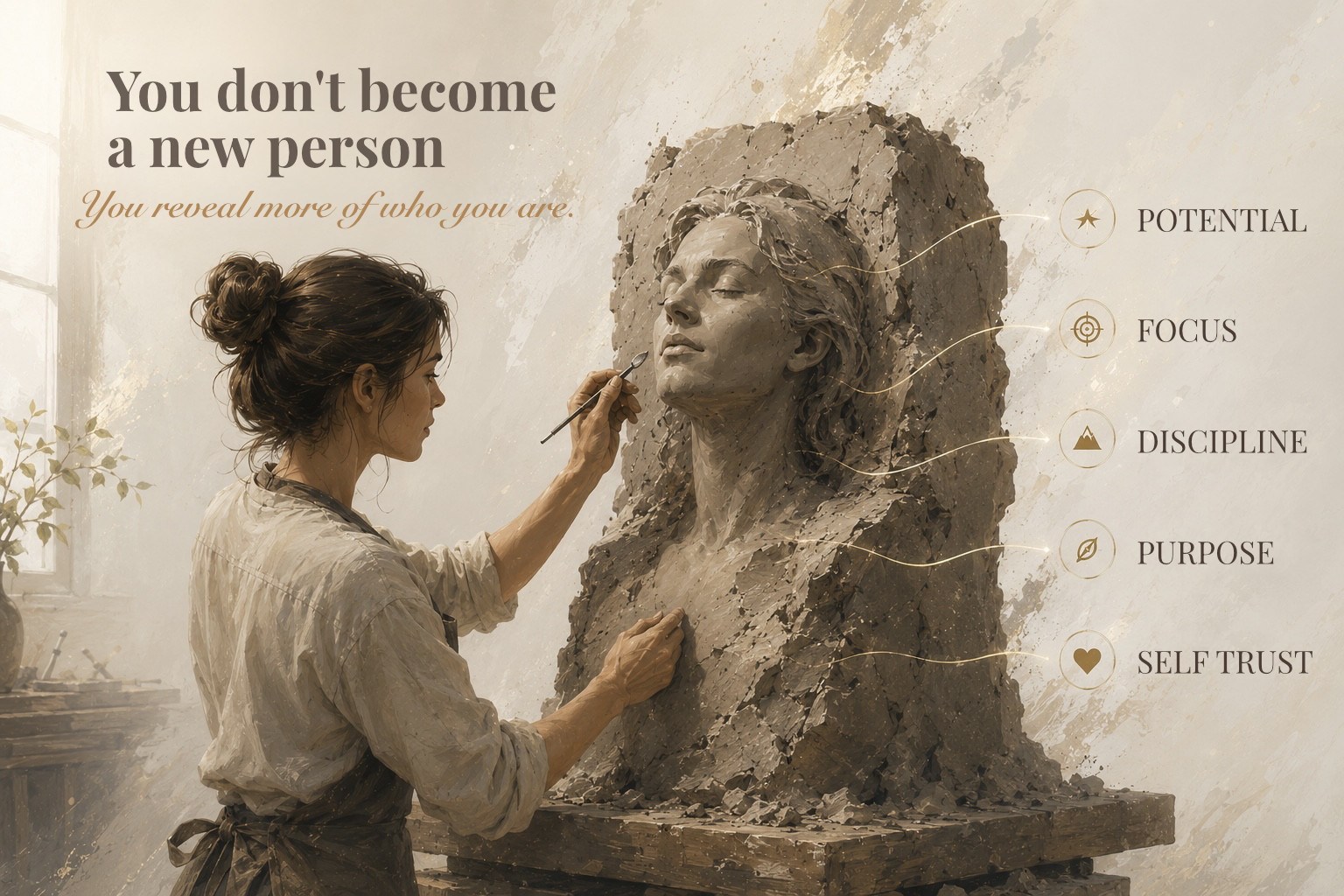
A sculptor shapes a human figure from clay beside the message “You don’t become a new person. You reveal more of who you are,” highlighting potential, focus, discipline, purpose, and self-trust.

When people hear the words personal development, they may wonder:

“Does this mean I need to change who I am?”

“Am I not already good enough?”

Personal development does not mean becoming someone else. It does not mean rejecting who you are today or replacing your personality with a different one.

I see it more like a sculptor working with clay.

The clay already has substance, character, and potential. The sculptor does not replace it but carefully works with what is already there, gradually bringing its shape forward.

That is how I see personal development: not creating a new person, but revealing more of the person who is already there.

Bringing Forward What Is Already Within You

We all have strengths, abilities, dreams, and qualities that may not yet be fully developed.

Some may be hidden beneath fear, doubt, old habits, or past experiences. Others simply need attention, practice, and the right tools before they can grow.

Personal development helps bring these qualities forward.

It may involve reading, learning new skills, reflecting on our behaviour, or becoming more aware of how we think and respond. It may also involve understanding our personality—our natural strengths, our tendencies, and the patterns that sometimes hold us back.

This does not mean becoming a different person.

It means becoming a stronger, wiser, and more conscious version of yourself.

Growth Still Requires Change

Personal development does not mean that everything about us should remain exactly as it is.

We may need to change habits that limit us. We may need to improve how we communicate, respond under pressure, treat other people, or lead ourselves through difficult situations.

But changing a behaviour is not the same as rejecting who we are.

Developing discipline—or building better habits, as I prefer to think of it—does not mean you had no value before. Becoming more patient, courageous, or thoughtful does not mean becoming someone else.

It means continuing to shape what is already there.

We Are Never Completely Finished

A sculpture may eventually be considered complete. Human beings are different.

There is always more we can learn about how we think, act, handle challenges, build relationships, and support the people around us.

We can develop new skills and rediscover dreams that may have been buried beneath everyday responsibilities.

Who we are today is not the limit of who we can become.

Start by Understanding Yourself

It is difficult to shape something we do not understand.

Self-awareness gives us a clearer picture of our strengths, our personality, and the patterns that may be holding us back.

A personality test cannot tell you who you must become. But it may help you understand more clearly who you already are—and where additional potential may be waiting to be developed.

You are not a problem that needs to be fixed.

You are a person who can continue to learn, grow, and bring forward more of what already exists within you.

The clay is already there.

The question is what you will choose to shape from it.

Want to understand more about the strengths and natural tendencies you already carry? Explore the Core Color Personality Test.

Related reading: Personal growth becomes easier when we understand both who we are and the habits that shape us. Read: Understand Yourself First and Are Your Habits Changing Your Life?

Was this article helpful?
YesNo

Similar Posts

  • |

    Be the Bridge

    Sometimes something feels easy when we do it as part of a job, but much harder when we do it for ourselves. At work, we may have no problem calling someone, sending an email, starting a conversation, or presenting an idea. We are representing a company or completing a task. But when we begin building something of our own, the same actions can suddenly feel personal.

    The phone feels heavier. We hesitate before sending the message. We begin wondering what the other person will think, how they will respond, and what their answer might say about us. A simple no can begin to feel like personal rejection. But perhaps there is another way to see it.

    Imagine a Backpack

    Imagine placing everything you have to offer inside a backpack. It could be a product, a service, an opportunity, an idea, knowledge, experience, or something else that can create genuine value for another person. You put the backpack on and carry it with you.

    When you contact someone, you are not asking them to approve of you. You are simply giving them the opportunity to look at what you carry. You are the messenger. You are also the bridge between the person and what is inside your backpack.

    Your responsibility is to build that bridge and make the offer honestly. Their responsibility is to choose.

    A No Is Not Always About You

    Think about how people choose grocery stores. Some people regularly shop at one store and would never choose another. Someone else may make the opposite choice. That does not mean either store has no value. People make different choices based on their preferences, needs, experiences, priorities, and current circumstances.

    It will be the same with what you carry. Some people will say yes. Some people will say no. Some people may say not now.

    Some will, some won’t—so what?

    Their answer does not automatically define the value of what you offer. More importantly, it does not define your value as a person.

    There is a saying I have learned through the business I do:

    “We are looking for the people who are looking for us.”

    That does not mean sitting still and waiting for those people to appear. We still need to reach out. We still need to start conversations and build bridges. But we do not need everyone to choose what we carry.

    Know the Value of What You Carry

    This way of thinking also comes with responsibility. Your backpack should contain something you genuinely believe can create real value for the people you approach.

    If you know that what you offer cannot help them, then confidence is not what you are building. You are simply creating false expectations.

    Before becoming proud of what you carry, make sure it is worthy of that pride. Understand what you offer, why it matters, and how it may help someone.

    When you are secure in that knowledge, reaching out can begin to feel different. You are not trying to mislead anyone or force them into a decision. You are offering them the opportunity to look at something you honestly believe may have value. They are still free to choose.

    Putting on the Backpack

    The backpack is not only an image. It can become a mental tool. Before making a call, sending a message, or starting a conversation, pause for a moment. Imagine putting on the backpack. Remind yourself that you are carrying something you believe in. Then remind yourself of your role:

    You are not responsible for making the other person say yes. You are not responsible for their timing, priorities, previous experiences, or personal preferences. You are responsible for taking the step, building the bridge, and giving them the opportunity to look.

    This can help create some distance between your identity and their answer. A no may still feel disappointing. But it does not need to become a judgment about who you are.

    Self-Leadership Through Action

    Some people find it easy to approach others without overthinking. For others, it requires courage. Neither person should be judged. We all carry different experiences, fears, strengths, and beliefs about ourselves.

    Self-leadership is not always about feeling confident before we act. Sometimes it means learning to guide ourselves through uncertainty and act even when confidence is not yet there.

    The more often you take the step, the more natural it can become. You begin learning that you can handle a no. You begin separating other people’s choices from your own value. You begin building confidence through action.

    The next time you feel uncertain about contacting someone, picture the backpack. Remember what you carry. Remember why you believe it has value. Put the backpack on, build the bridge, and take the next step.

    Your responsibility is to offer. Their responsibility is to choose.


    Related reading: Our fear of rejection is often connected to our need to feel accepted and understood. Read The Need for Acceptance.

    Do your emotions sometimes influence whether you take action or hold yourself back? Explore the Emotional Style Test.

    Want to understand how you lead yourself when something feels uncomfortable or uncertain? Explore the Leadership Style Test.

    Was this article helpful?
    YesNo
  • |

    When You Lose Your Drive

    There was a time in my life when I couldn’t wait to get out of bed in the morning.

    I was excited about what I was building. I attended meetings, listened to several audio programs every day, read constantly, and invested countless hours in personal growth. More importantly, I loved helping other people pursue their goals and dreams. It didn’t feel like work. It felt meaningful.

    Looking back, I realize how much energy and enthusiasm I had during that period of my life. Then something changed.

    A series of experiences involving people I trusted deeply had a much greater impact on me than I realized at the time. To be clear, I take full responsibility for the decisions I made. The choices were mine. They always were. But the guidance, influence, and disappointment that followed left a mark that stayed with me for years.

    What surprised me most wasn’t what happened. It was what happened afterward.

    I lost my drive.

    The passion that had fueled me for years seemed to disappear. Activities that had once inspired me suddenly created resistance. I didn’t want to listen to educational material. I didn’t want to attend meetings. Books that once excited me stayed closed on the shelf.

    It wasn’t that I suddenly disliked personal development. It wasn’t that I hated the business environment. It wasn’t even that I had stopped believing in growth. The problem was that my mind had connected those experiences with pain.

    For years, I tried to get that drive back. I read books about motivation. I studied goal setting. I learned about habits, mindset, success principles, and how the brain works. Sometimes I would find a new approach that seemed promising. It would work for a few months, and I would feel momentum building again.

    Then it would fade. And I would find myself back at the starting line.

    If you’ve ever experienced something similar, you know how frustrating that can be. Especially when you remember who you used to be. You know what you’re capable of. You know what it feels like to be driven. You know what it feels like to wake up excited about the future. Yet somehow, you can’t seem to get back there.

    For a long time, I thought the answer was to find a bigger goal. Or a stronger purpose. Or more motivation. So I kept searching. I read more books. I listened to more advice. I tried different systems and approaches.

    But eventually I began to question something.

    What if I was asking the wrong question?

    Instead of asking, “What is my purpose?” maybe I should have been asking, “Who do I want to become?” That shift changed everything.

    Recently, while reflecting on this journey, I decided to revisit some of the books I had collected over the last twenty years. My bookshelves are filled with books on leadership, personal growth, success, motivation, communication, and psychology.

    One of the books that stood out was Atomic Habits by James Clear. I had read it before. But this time, I looked at it differently.

    What struck me wasn’t the discussion about habits. It was the focus on identity. The idea that lasting change doesn’t start with goals. It starts with the person you want to become.

    That concept resonated with me far more than another goal-setting exercise ever could.

    If someone wants financial freedom, perhaps the first question isn’t, “How do I become financially free?”

    Maybe the better question is: “What kind of person creates financial freedom?”

    How does that person think? How do they spend their time? What habits do they practice consistently? How do they respond when things don’t go according to plan?

    The same can be asked about almost any goal in life. Before focusing on the outcome, perhaps we should focus on becoming the person capable of creating that outcome.

    Will this approach work for everyone? Probably not. And that’s an important point.

    We’re all different. We have different backgrounds, different personalities, different experiences, and different challenges. The tools that help one person move forward may not help another person at all. That’s okay.

    The goal isn’t to find a solution that works for everyone. The goal is to find what works for you.

    For me, this realization has been helpful because it shifted my attention away from constantly searching for motivation and toward building a stronger foundation. Instead of chasing a feeling, I’m trying to focus on becoming the kind of person I want to be.

    The truth is that we all go through periods where we struggle. We lose confidence. We lose momentum. We question ourselves. We wonder if we’ll ever find our passion again.

    But perhaps the answer isn’t always to look further ahead. Sometimes the answer is to look deeper. To ask different questions. To challenge old assumptions. And to remember that growth isn’t always about finding the perfect path.

    Sometimes it’s simply about taking the next step and continuing to move forward.

    If you’ve been struggling to find your drive, your purpose, or your motivation, I hope this reflection gives you something to think about. Not because it contains all the answers. But because it might help you ask a different question.

    And sometimes, a different question is exactly where change begins.

    Related reading: Losing your drive can bring doubt and uncertainty, but small daily actions can also help rebuild momentum. Read: Fear and Doubt Are Part of Growth and Are Your Habits Changing Your Life?

    Want to understand what truly drives you and how to rebuild momentum when motivation fades? Learn more about the Goal Style Test.

    Was this article helpful?
    YesNo
  • The Courage to Be Visible

    Building a website is one thing.

    Putting your thoughts online is another.

    But showing yourself — your face, your voice, your personality — on video is a completely different level of exposure.

    When you see yourself on camera, it’s very easy to become your own harshest critic.

    You notice everything.

    How you speak.
    How you look.
    How you move.
    Whether you sound confident enough.

    I’ve experienced that myself while recording videos for Equipido.

    You watch the video back and think:
    “Could I have said that better?”
    “Do I really look like that?”
    “Should I record it again?”

    But at some point, you have to accept something very simple.

    This is who I am.

    This is how I speak.

    This is how I look.

    And the biggest judge in the room is often not other people.

    It’s ourselves.

    Once you accept that everything doesn’t need to be perfect, something changes. You stop trying to control every small detail and start focusing on the message instead.

    Some people will appreciate it.

    Some people won’t.

    That’s part of being visible.

    But if you wait until everything feels perfect before you share something with the world, you will probably never share anything at all.

    Related reading: Fear and doubt often appear when we choose to be visible and share who we are. Read: Fear and Doubt Are Part of Growth.

    Want to understand how your emotional patterns shape the way you handle vulnerability, fear of judgment, and being seen? Learn more about the Emotional Style Test.

    Was this article helpful?
    YesNo
  • |

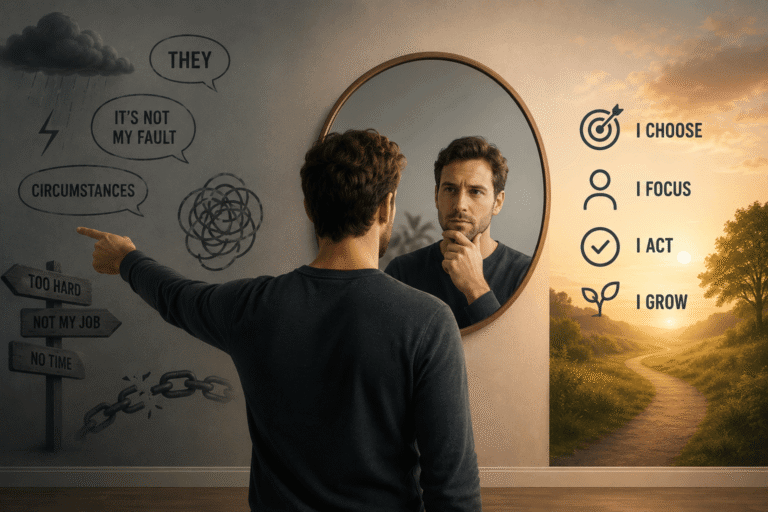
    The Blame Game


    When something does not go our way, it is often easy to find someone or something else to blame.

    It was because of my boss. My partner made it difficult. Everyone else does the same thing. I did not have the right opportunity. The circumstances were against me.

    Sometimes those things may even be true. There are circumstances in life that we cannot control, and there are things that happen to us that are genuinely not our fault.

    But there is a danger when blaming others becomes our normal response. Because the moment everything becomes someone else’s fault, we also remove responsibility from ourselves. And if we have no responsibility, we have no reason to take action.

    That is where the blame game can begin to hold us back.

    What Can You Actually Control?

    I am not saying that everything that happens in our lives is our fault. It is not.

    There are things we cannot control. Other people make decisions that affect us. Companies change. Relationships end. We may experience difficult circumstances, illness, loss, or things from our past that we never chose.

    But even when we cannot control what happens, we often still have some control over what we do next. That distinction is important.

    Instead of asking only, “Whose fault is this?” perhaps a more useful question is:

    What can I do about it now?

    That question brings responsibility back to us. And with responsibility comes the possibility of change.

    The Everyday Blame Game

    The blame game does not always appear in major life situations. Often it shows up in very ordinary things.

    Imagine that I want to lose weight, but my partner regularly brings home chips, sweets, and other things I am trying not to eat.

    I could say: “If my partner did not buy those things, I would not gain weight.”

    And yes, perhaps it would be easier if my partner supported my goal and did not bring those things home. But my partner is still not the person putting the food in my mouth. That choice is mine.

    Or perhaps I am unhappy with how much I earn.

    “My employer will not pay me more.”

    That may be completely true. Maybe the company cannot afford to pay more. Maybe they do not believe my current performance justifies a higher salary. Maybe there are other reasons.

    But what can I do?

    I can ask what I need to improve. I can develop new skills. I can become better at what I do. I can look for another position. I can find another way to increase my income.

    I may not be able to control what my employer decides. But I can control what I decide to do next.

    The same applies to something as simple as arriving late to work.

    “But everyone else comes late.”

    Maybe they do. But everyone else is not responsible for when I arrive. I am.

    Responsibility Gives You Options

    This is why I believe the blame game can be so damaging when we want to change our lives. Not physically damaging, perhaps, but damaging to our growth.

    If I constantly believe that other people are responsible for where I am, then I also give those people control over whether my life can change.

    I want more freedom, but someone else is stopping me. I want better health, but someone else makes it difficult. I want a better career, but my employer will not give me the opportunity. I want to fulfil my dreams, but my circumstances are wrong.

    If everything depends on someone else changing first, I may wait for a very long time.

    But when I begin asking what I can change, something happens. I get options again.

    Not always easy options. Not always quick ones. But options.

    What Are Your Mistakes Teaching You?

    Blaming others can also prevent us from learning from our mistakes.

    John C. Maxwell wrote a book called Failing Forward, built around the idea that failure and mistakes can become part of our growth when we learn from them.

    I believe there is a lot of truth in that.

    We are going to make mistakes. I have made many, and I will make more. But if every mistake immediately becomes somebody else’s fault, what am I supposed to learn from it?

    If I say, “It happened because of them,” I can walk away without examining my own decisions.

    If instead I ask, “What could I have done differently?” I may discover something that helps me the next time.

    That does not mean taking responsibility for things that genuinely belonged to someone else. It means being willing to look honestly at the part that belonged to me.

    Sometimes the Blame Goes Back Years

    The blame game can also reach much further back. We can blame our childhood, our parents, previous relationships, lost opportunities, or things that happened many years ago.

    This is something I can relate to personally.

    I had a difficult childhood, and of course experiences from those years affected me. I cannot pretend they did not.

    But at some point I had to ask myself another question:

    Why should I allow what happened then to decide the rest of my life?

    I cannot change what happened. I cannot go backwards and create another childhood. But I can decide what I want to do with my life from here.

    The past may explain some of the way we think, react, or behave today. Understanding that can be important. But explanation does not have to become a life sentence.

    At some point, if I want something different, I have to begin taking responsibility for building something different.

    That is part of the inner journey.

    Change What You Can Change

    Sometimes we make change much more complicated than it needs to be.

    I do not have enough money. What can I change?

    I am unhappy with my health. What can I change?

    I do not like where my career is going. What can I change?

    I keep ending up in the same situation. What can I change?

    Notice that I am asking what, not how. Many people get stuck at “How am I going to do this?” and immediately see everything they do not have or cannot do. First become clear about why you want the change and what you want to change. When your why and your what are clear, the how often becomes easier to see.

    The answer may not be immediate, and the solution may require time, effort, learning, difficult conversations, or uncomfortable decisions.

    But blaming someone else rarely moves us forward.

    A fast-food restaurant is not responsible for the fact that I stopped there when I was hungry. The restaurant can be directly on my way home, with a huge sign in front of me, but I am still the one who turns the car into the parking lot.

    That does not mean every choice is easy. It means it is still a choice.

    Step Out of the Blame Game

    Perhaps one of the most useful things we can do is become aware of how often we blame circumstances or other people.

    Not so that we can start blaming ourselves instead. That is not the point.

    The point is to recognise where our own responsibility begins.

    When something goes wrong, we can ask:

    What part of this could I control?
    What could I have done differently?
    What can I learn from it?
    What can I do now?

    There will always be things outside our control. But we do not need to give those things control over everything that happens next.

    Taking responsibility does not change the past.

    It changes what we are able to do with the future.


    Related reading: Growth often requires us to look at our own patterns before looking at everyone around us. Read Understand Yourself First.

    Do you tend to act quickly, avoid decisions, or look outside yourself when choices become difficult? Explore the Decision Style Test.

    How do you respond when things go wrong or emotions become difficult? Explore the Emotion Style Test.

    Was this article helpful?
    YesNo
  • |

    Your Best Investment

    We often talk about investments. Investing in stocks. Investing in funds. Investing in property. Investing in a business. Investing in something that may grow over time and hopefully create a better future.

    All of that can be valuable. But I believe there is one investment that comes before many others.

    The investment we make in ourselves.

    Because no matter what we want to build, improve, change, or create, we bring ourselves into it. Our thinking. Our habits. Our knowledge. Our attitude. Our discipline. Our communication. Our ability to handle setbacks. Our ability to learn.

    If those things do not grow, it becomes much harder for anything else to grow.

    A person can invest money without understanding what they are doing. A person can start a business without developing the skills needed to run it. A person can begin a health journey without learning how to build habits that last. A person can set goals without understanding what kind of person they need to become in order to reach them.

    That is why personal development matters.

    For me, investing in myself has been one of the most valuable things I have done. I do not say that because I am finished, or because I have everything figured out. I am not where I want to be in every area of life.

    But I can see clearly that the books I have read, the seminars I have attended, the education I have received, and the personal development I have worked with have shaped how I think, how I act, and how I look at the future.

    It has not made me into someone else. Maybe that is the wrong way to look at growth.

    I do not think personal development turns us into a completely different person. I think it helps bring out more of what is already inside us.

    It is a little like a block of stone. At first, it may look rough, unclear, and unfinished. But as the work continues, something begins to appear. The shape becomes clearer. The unnecessary parts are removed. The sculpture was not created from nothing. It was revealed through the process.

    I think growth can work in a similar way.

    The more we learn, the more we discover about ourselves. The more we develop, the more we notice both our strengths and the areas where we still need to grow. And the more we understand, the more we also realize how much we still do not know.

    That is not a weakness. That is part of the process.

    Investing in ourselves does not always produce an immediate result that can be measured in money. Sometimes the result shows up in our thinking. Sometimes it shows up in our attitude. Sometimes it shows up in how we handle pressure, how we communicate, how we make decisions, or how we respond when life does not go the way we planned.

    That kind of return may be difficult to calculate, but it can still be extremely valuable.

    If we invest in our health, we may gain more energy, confidence, strength, and quality of life. If we invest in our mindset, we may begin to see possibilities where we previously saw only problems. If we invest in communication, we may improve our relationships, our leadership, and our ability to work with other people.

    If we invest in financial education, we may make better decisions with money. If we invest in personal development, we may begin to understand ourselves on a deeper level and create a better direction for our future.

    That is why I believe this kind of investment is so important.

    It is not only about reading a book or attending a seminar. Those things can be powerful, but only if we use them. A book on a shelf does not change much. A course we never apply does not create much growth. A seminar may inspire us, but inspiration alone is not enough.

    The real value comes when we take what we learn and begin to live it.

    That is when information becomes transformation.

    Before choosing where to invest time, money, or energy, I think it helps to ask a few honest questions.

    What do I want to improve? What kind of person do I need to become? What knowledge am I missing? What habits are holding me back? What area of my life would change the most if I became better prepared?

    Those questions matter because self-investment is not only one thing. It can look different depending on what we need.

    For one person, investing in themselves may mean joining a health program, learning how to eat better, move more, and build routines that support a better lifestyle.

    For another person, it may mean taking a course in investing, business, leadership, communication, or personal finance.

    For someone else, it may mean reading books that challenge their thinking, finding a mentor, attending a seminar, or learning a skill that opens new possibilities.

    It may also mean building something on the side while still doing what they do today. If someone wants more options in the future, they may need to invest in the knowledge, habits, and skills required to create those options.

    In many cases, the future we want requires a version of ourselves we have not fully developed yet. That can be uncomfortable, but it can also be encouraging.

    Because it means growth is possible.

    We are not stuck only with what we know today. We can learn. We can improve. We can become more disciplined. We can become better communicators. We can become more aware. We can become stronger in the areas that matter to us.

    But it usually does not happen by accident. It happens because we choose to invest in it.

    I think one mistake many people make is that they look for better results before they look at who they are becoming. They want better finances, better health, better relationships, better confidence, better opportunities, or better leadership.

    But many of those results are connected to personal growth.

    If I want better health, I may need better habits. If I want better finances, I may need better financial understanding. If I want better relationships, I may need better communication. If I want better leadership, I may need better self-awareness. If I want better opportunities, I may need to become better prepared.

    This is why investing in yourself is not selfish. It can actually make you more valuable to others.

    When you grow, you often bring more value to your family, your work, your business, your team, and the people around you. You become better equipped to contribute, support, lead, communicate, and make decisions.

    That is a return that can affect more than just yourself.

    For me, books have played a big role in this. Not every book will change a life. Not every course will be useful. Not every seminar will create a breakthrough. But when the right idea meets the right moment, it can shift the way we see ourselves and our future.

    Sometimes one idea can change how we think. Sometimes one habit can change the direction of a year. Sometimes one decision to grow can open doors that were not visible before.

    That is why I keep coming back to this thought:

    Before investing only in what is outside of us, maybe we should also ask how much we are investing in what is inside of us.

    Our thinking. Our knowledge. Our discipline. Our health. Our communication. Our self-awareness. Our ability to grow.

    Because everything we build is affected by the person we are becoming.

    And if we want a better future, one of the most practical places to start may be with ourselves.

    Related reading: A good investment in yourself often starts with what you read and how you apply it. Read: Are You Reading Books—or Just Owning Them?

    Want to better understand yourself and discover where your greatest opportunities for growth lie? Learn more about the Core Color Personality Test.

    Was this article helpful?
    YesNo
  • |

    Are You Reading Books—or Just Owning Them?

    A book can be many things.

    It can be something beautiful to keep on a shelf. It can be something you collect, organize, and feel proud to own. Maybe you have 200 books, 300 books, or even more, standing neatly in your library with barely a mark on them.

    And there is nothing wrong with that. Some books are special. Some are signed. Some have personal meaning. Some are worth keeping clean and untouched.

    But when we talk about books on personal development, leadership, communication, habits, or growth, I think we need to ask a different question.

    Why did we buy the book in the first place?

    Was it to make the bookshelf look better, or was it because we wanted to learn something, change something, understand something, or become better in some area of life?

    In my opinion, a book is not just something to own. A book is a tool.

    Someone may have spent years, sometimes decades, building the knowledge, experience, stories, lessons, failures, and insights that ended up inside those pages. In some cases, a book may represent a large part of a person’s life work, compressed into 200 or 300 pages.

    When you open that book, you are not just reading words. You are getting access to someone’s experience. You are getting access to ideas that may have taken them years to understand. And you can receive those ideas in a matter of hours.

    That is powerful, but only if we use the book.

    I know many people are careful with their books. They do not want to write in them. They do not want to fold a page. They do not want to underline anything. Maybe they were taught growing up to be careful with books, and of course, there is value in taking care of things.

    But if the book is a tool for your growth, then I believe you should not be afraid to use it.

    Write in it. Underline important sentences. Fold a page if you need to. Put notes in the margin. Mark the parts that challenge you, inspire you, or make you stop and think.

    Be a little wild with it.

    Because the purpose of the book is not only to stay in perfect condition. The purpose of the book is to help you grow.

    Of course, there are exceptions. I have books that I do not write in. I have signed books from authors that are special to me, and I leave those untouched. But when I want to really study a book, I often have another copy that I use as a working tool.

    That is the difference for me. Some books are keepsakes. Other books are tools. And when a book is a tool, I want to use it fully.

    Today, I often use several versions of the same book. I may have the physical book. I may have the Kindle version. And sometimes I also listen to the audiobook.

    For example, Atomic Habits contains so many useful ideas that reading it once is not enough for me. I can read the book in 10 or 12 hours, but that does not mean I have absorbed everything James Clear has put into it.

    There is a big difference between finishing a book and truly learning from it.

    That is why I like using highlights, notes, and repetition. With Kindle, I can mark important sections, export my highlights, and then sit down later to study them more carefully. With an audiobook, I can listen while walking, driving, or preparing breakfast. With a physical book, I can mark the pages and write my own thoughts directly beside the author’s ideas.

    Each format gives me a different way to connect with the material. And that leads to another important point: a book is not only a reading tool. It can also be a reflection tool.

    When I read a good personal development or leadership book, I do not just want to ask, “What did the author say?” I also want to ask: How does this apply to my life? Where am I already doing this? Where am I not doing this? What should I change? What is one thing I can start applying today?

    That is where the real value begins.

    Because reading a book does not automatically change your life. Studying it might. Applying it might. Returning to it might. Teaching it to someone else might.

    Another powerful way to use a book is to study it together with other people.

    This can be done in a mastermind group, a study group, a team, or even with just one friend. Some time ago, a friend and I did exactly that. We chose a book, read one chapter each week, and then met for a one-hour video call to discuss it.

    The purpose was not just to talk about the chapter. The purpose was to ask what the ideas meant, how they applied to our lives, and how we could use them practically in everyday life and in business.

    That kind of discussion can make a book much more valuable. You hear another person’s perspective. You explain your own thoughts. You are forced to think more deeply about what you have read. And sometimes, that is when the book really starts to become useful.

    If you are building an organization, leading people, developing yourself, or helping someone else grow, books can become practical tools. A book like The Magic of Thinking Big, a John Maxwell book, or another leadership book can be something you read for yourself, but it can also be something you recommend or lend to someone who is just beginning their own journey.

    But if you are going to recommend a book, it helps to have studied it yourself. Not just read it once. Studied it.

    Because then you know why it matters. You know what parts are useful. You know what questions it raises. You know how it can help someone think differently.

    That is why I think the question “What is a book?” is more important than it first sounds.

    For some people, a book is decoration. For some people, it is entertainment. For some people, it is a collector’s item. For some people, it is a tool.

    None of those answers are automatically wrong. But I think we need to be honest with ourselves.

    When it comes to books about growth, leadership, habits, communication, or success, why are we buying them? Are we mainly buying them to own them, or are we buying them to use them?

    Because if the goal is growth, then the book needs to become more than something that sits on a shelf. It needs to become part of the process.

    Maybe that means writing in it. Maybe it means highlighting. Maybe it means listening to it more than once. Maybe it means exporting your notes and studying them. Maybe it means discussing it with someone else. Maybe it means taking one idea and applying it for the next week.

    The point is not that everyone has to use books the same way.

    The point is to consider whether every book needs to be treated as something fragile, especially when the real value is not in keeping the pages perfect.

    The real value is in what the book helps you understand, change, and apply.

    So maybe the next time you pick up a book, especially a book about personal growth or leadership, ask yourself: What is this book for?

    Is it something I want to keep perfect?

    Or is it something I want to use?

    For me, many of my books are tools.

    And a tool is meant to be used.

    Want to understand what helps you turn insight into action and follow through on the growth you want? Learn more about the Goal Style Test.

    Was this article helpful?
    YesNo
Leave a Reply

Your email address will not be published. Required fields are marked *