
·

Sometimes the Lesson Is the Result

Desk with an old computer, scattered papers and a sketchbook filled with plans and diagrams

Around 15 or 20 years ago, I had an idea to build an online community for Christians. Something similar to a social network.

I believed in the idea, even though very few people around me did. This was long before AI made it possible to build things the way we can today, so I paid people to help me develop it. I invested a significant amount of money in the project.

It never became what I had imagined.

But I do not look at that money as wasted.

The experience helped me see something about myself. I was very good at coming up with ideas and creating things. But at that time, I was not equally good at driving them forward and turning them into something sustainable.

That was an important lesson.

Having an idea and being able to create something is one part. Being able to take it further is another. Through that project, I began to understand the difference in myself.

People spend money on education all the time. In many ways, that project was part of my education.

When we believe in an idea, we naturally want it to work. We have a picture of what it could become, and we put time, money, and effort into trying to make it happen.

But believing in something does not guarantee that it will work.

We may discover that part of the idea was wrong. We may need to learn something, change direction, or start again.

Sometimes the return is not the business we hoped to build. Sometimes it is what the experience teaches us about ourselves.

For me, that project showed me an area where I needed to grow. It did not become what I had wanted, but I learned something important from having tried.

If something does not work, I believe we need to look at what we can learn from it. If something needs to change, change it. Then keep moving.

I cannot say that every idea will succeed. My own experience tells me otherwise.

But I can look back at that project and see more than something that did not work. I can see what it taught me about the way I create, the way I work, and what I still needed to develop.

That was not the result I had imagined. But it was still something valuable to take with me.

Related reading: What we learn through experience is part of the investment we make in ourselves. Read: Your Best Investment


Was this article helpful?
YesNo

Similar Posts

  • |

    Are You Good at Something That Is Keeping You Still?

    Sometimes we find something we are good at. We understand it, feel comfortable doing it, and other people recognise us for it. They may ask for our advice or appreciate what we do. Maybe they even begin to see us as an expert.

    There is nothing wrong with that. But it can also become a very comfortable place to stay.

    When people notice us and make us feel appreciated, it is easy to think that we should keep putting our energy there. We know what we are doing. We feel confident. We feel useful.

    But there is a question I think we need to ask ourselves:

    Is this actually taking me where I say I want to go?

    Something can make us feel successful today without moving us toward the future we say we want. We may enjoy being in an environment where we feel respected while avoiding another area where we know we need to grow.

    I know this because I have done it myself. There are things I am comfortable doing and things that require much more from me. Some days, I would much rather stay with what I already know than put myself in a situation where I feel like a beginner again.

    Perhaps there is a conversation I would rather avoid. Perhaps there is a risk of rejection. Perhaps the next step means doing something I am not yet good at.

    It is easier to keep doing something that makes us feel good. But if the uncomfortable part is standing between us and where we want to go, avoiding it does not make it disappear.

    There is nothing wrong with changing a goal. What we wanted before may no longer be what matters to us now.

    But if I still want that goal, I need to be honest about whether my actions are taking me there. Am I working toward it, or am I staying where I feel confident and appreciated?

    At some point, I have to make a choice. Either change the goal or begin working on the things that are keeping me from it.

    Being good at something can be valuable. But I still need to ask whether it is where I want to stay.

    Related reading: Recognising where comfort holds us back can help us understand why we avoid the next step. Read: The Hidden Danger of the Comfort Zone

    Was this article helpful?
    YesNo
  • Discipline Is Not What Most People Think

    The word discipline often has a negative tone.

    For many people it sounds like something rigid, strict, and monotonous — waking up early every day, following strict routines, and forcing yourself to do things you don’t want to do.

    But discipline doesn’t always look like that.

    While building Equipido, I’ve probably spent more than 2,500 hours working on the platform.

    Yet I’ve never really experienced it as discipline in the traditional sense.

    I didn’t wake up every morning thinking, I must force myself to do this.

    Instead, I had something driving me forward.

    A purpose.

    A goal.

    I wanted to create something that could genuinely help people understand themselves better and grow from that understanding.

    When you have that kind of purpose, long hours don’t always feel like discipline.

    They feel like progress.

    There were periods where I could wake up very early, work long days, and stay focused for hours — not because I forced myself to, but because I was driven by something meaningful.

    So maybe discipline isn’t always about strict routines.

    Sometimes discipline is simply what happens when purpose becomes strong enough.

    Want to understand what truly fuels your goals and turns purpose into consistent action? Learn more about the Goal Style Test.

    Was this article helpful?
    YesNo
  • The Hidden Danger of the Comfort Zone

    Comfort zones feel safe.

    They are familiar. Predictable. Controlled.

    But comfort zones can also quietly become one of the biggest obstacles to personal growth.

    When we stay in what feels comfortable, we rarely challenge ourselves. We repeat the same patterns, make the same decisions, and surround ourselves with the same environments.

    Nothing feels difficult — but nothing truly changes either.

    Growth almost always requires stepping into situations that feel unfamiliar or uncomfortable.

    That might mean speaking in front of people, sharing your ideas publicly, starting something new, or putting yourself in situations where you know others might disagree with you.

    Those moments can feel uncomfortable because they remove the protection of certainty.

    But discomfort is often a signal that something important is happening.

    It means we are stretching beyond our current limits.

    The comfort zone is not dangerous because it feels bad.

    It’s dangerous because it feels good enough to keep us there.

    And if we stay there too long, we slowly stop moving forward.

    Related reading: Fear and doubt often appear when we step outside our comfort zone. Read: Fear and Doubt Are Part of Growth

    Want to understand how your decision patterns influence whether you stay with what feels safe or move toward change? Learn more about the Decision Style Test.

    Was this article helpful?
    YesNo
  • |

    The Mental Prison

    Sometimes we are held back by something we are not even aware of. A mental prison.

    We grow up surrounded by other people’s values, beliefs, and ways of looking at life. We learn from our parents, the people around us, and later from school and work. Much of that becomes so familiar that we never really question it.

    We learn how things are supposed to be. How we are supposed to fit in. What we are supposed to do. And often, we follow that path without knowing what other paths might exist.

    Get an education. Find a good, secure job. That was the direction I learned.

    There is nothing wrong with that. If you enjoy your work and the life you are building, then you should do what feels right for you. But I think there is a difference between choosing a path and following it because it is the only one you know.

    The people around us may have followed the same path themselves. They passed on what they knew. They may never have been introduced to anything different either.

    When I was at school, I did not learn how to make money work for me. I did not learn that from my parents either. I understood working for money. Exchanging my time for an income. But financial understanding beyond that was something I had to begin learning for myself.

    The knowledge simply was not there in the environment I grew up in. And when we do not know that other possibilities exist, it is difficult to see them as choices.

    I think the way we learn to look at mistakes can become part of this too. At school, getting an answer wrong was something negative. But in life, mistakes can be part of how we learn.

    When I listen to people who have built something significant, I often hear them talk about how many things went wrong along the way. They made mistakes. They tried things that did not work.

    That is a very different picture from the idea that getting something wrong means you have failed. If we carry that fear of being wrong with us, it can become another part of the mental prison.

    For me, the beginning is curiosity. Being willing to ask whether there might be something beyond the way we have always done things. If you are reading blogs like this, perhaps you have already started that journey.

    We can read. We can listen. We can learn from people who have done something we would like to do. There is material about financial understanding, emotional intelligence, personal development, and leadership. There are books and podcasts that can introduce us to ideas we were never taught.

    Those were not things I remember learning at school. I had to look for them myself.

    I have also thought about the education we receive through work. In the jobs I have had, I have not felt that the purpose was to help me build the life I wanted or understand how to create something of my own. The education was connected to what the company needed.

    We may be sent on a course or given an opportunity to travel somewhere for training. That can feel good. We feel that someone is investing in us. But I think it is worth understanding why that investment is being made.

    From my experience, the company expects it to benefit the business. That is how I have understood it. Others may have had different experiences.

    But for me, it meant that I could not expect my workplace to take responsibility for all the things I needed to learn for my own future.

    When we begin learning about other possibilities, something changes. We have more to base our decisions on.

    We may still choose the work we already do. We may want the security of a regular job. We may decide to build something of our own or explore another direction. But now we know there are alternatives. That is what matters to me.

    I am not saying that one way of living is right for everyone. If you enjoy what you do, keep doing it. But I want that decision to be made on my own terms, with an understanding of what else might be possible.

    Because when we can see beyond the path we grew up with, we can begin making a choice that is truly our own.

    Related reading: Becoming aware of the paths we have learned to follow can also change how we think about work, time, and freedom. Read: Who Really Controls My Time?

    Was this article helpful?
    YesNo
  • |

    The Blame Game


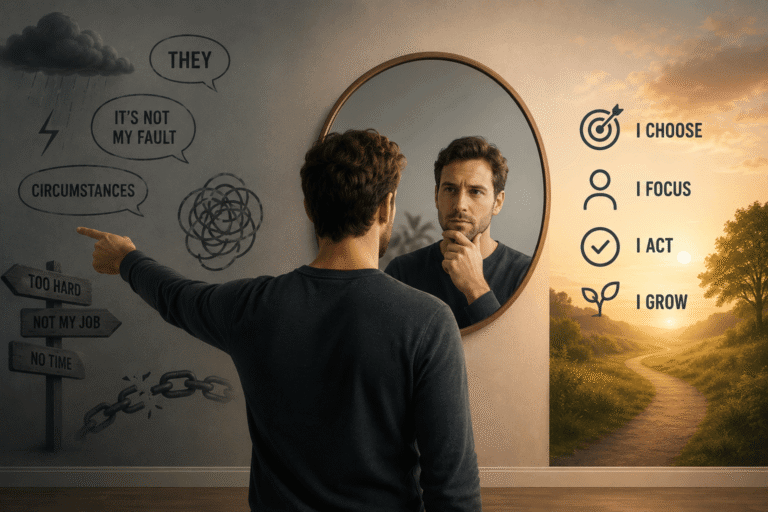
    When something does not go our way, it is often easy to find someone or something else to blame.

    It was because of my boss. My partner made it difficult. Everyone else does the same thing. I did not have the right opportunity. The circumstances were against me.

    Sometimes those things may even be true. There are circumstances in life that we cannot control, and there are things that happen to us that are genuinely not our fault.

    But there is a danger when blaming others becomes our normal response. Because the moment everything becomes someone else’s fault, we also remove responsibility from ourselves. And if we have no responsibility, we have no reason to take action.

    That is where the blame game can begin to hold us back.

    What Can You Actually Control?

    I am not saying that everything that happens in our lives is our fault. It is not.

    There are things we cannot control. Other people make decisions that affect us. Companies change. Relationships end. We may experience difficult circumstances, illness, loss, or things from our past that we never chose.

    But even when we cannot control what happens, we often still have some control over what we do next. That distinction is important.

    Instead of asking only, “Whose fault is this?” perhaps a more useful question is:

    What can I do about it now?

    That question brings responsibility back to us. And with responsibility comes the possibility of change.

    The Everyday Blame Game

    The blame game does not always appear in major life situations. Often it shows up in very ordinary things.

    Imagine that I want to lose weight, but my partner regularly brings home chips, sweets, and other things I am trying not to eat.

    I could say: “If my partner did not buy those things, I would not gain weight.”

    And yes, perhaps it would be easier if my partner supported my goal and did not bring those things home. But my partner is still not the person putting the food in my mouth. That choice is mine.

    Or perhaps I am unhappy with how much I earn.

    “My employer will not pay me more.”

    That may be completely true. Maybe the company cannot afford to pay more. Maybe they do not believe my current performance justifies a higher salary. Maybe there are other reasons.

    But what can I do?

    I can ask what I need to improve. I can develop new skills. I can become better at what I do. I can look for another position. I can find another way to increase my income.

    I may not be able to control what my employer decides. But I can control what I decide to do next.

    The same applies to something as simple as arriving late to work.

    “But everyone else comes late.”

    Maybe they do. But everyone else is not responsible for when I arrive. I am.

    Responsibility Gives You Options

    This is why I believe the blame game can be so damaging when we want to change our lives. Not physically damaging, perhaps, but damaging to our growth.

    If I constantly believe that other people are responsible for where I am, then I also give those people control over whether my life can change.

    I want more freedom, but someone else is stopping me. I want better health, but someone else makes it difficult. I want a better career, but my employer will not give me the opportunity. I want to fulfil my dreams, but my circumstances are wrong.

    If everything depends on someone else changing first, I may wait for a very long time.

    But when I begin asking what I can change, something happens. I get options again.

    Not always easy options. Not always quick ones. But options.

    What Are Your Mistakes Teaching You?

    Blaming others can also prevent us from learning from our mistakes.

    John C. Maxwell wrote a book called Failing Forward, built around the idea that failure and mistakes can become part of our growth when we learn from them.

    I believe there is a lot of truth in that.

    We are going to make mistakes. I have made many, and I will make more. But if every mistake immediately becomes somebody else’s fault, what am I supposed to learn from it?

    If I say, “It happened because of them,” I can walk away without examining my own decisions.

    If instead I ask, “What could I have done differently?” I may discover something that helps me the next time.

    That does not mean taking responsibility for things that genuinely belonged to someone else. It means being willing to look honestly at the part that belonged to me.

    Sometimes the Blame Goes Back Years

    The blame game can also reach much further back. We can blame our childhood, our parents, previous relationships, lost opportunities, or things that happened many years ago.

    This is something I can relate to personally.

    I had a difficult childhood, and of course experiences from those years affected me. I cannot pretend they did not.

    But at some point I had to ask myself another question:

    Why should I allow what happened then to decide the rest of my life?

    I cannot change what happened. I cannot go backwards and create another childhood. But I can decide what I want to do with my life from here.

    The past may explain some of the way we think, react, or behave today. Understanding that can be important. But explanation does not have to become a life sentence.

    At some point, if I want something different, I have to begin taking responsibility for building something different.

    That is part of the inner journey.

    Change What You Can Change

    Sometimes we make change much more complicated than it needs to be.

    I do not have enough money. What can I change?

    I am unhappy with my health. What can I change?

    I do not like where my career is going. What can I change?

    I keep ending up in the same situation. What can I change?

    Notice that I am asking what, not how. Many people get stuck at “How am I going to do this?” and immediately see everything they do not have or cannot do. First become clear about why you want the change and what you want to change. When your why and your what are clear, the how often becomes easier to see.

    The answer may not be immediate, and the solution may require time, effort, learning, difficult conversations, or uncomfortable decisions.

    But blaming someone else rarely moves us forward.

    A fast-food restaurant is not responsible for the fact that I stopped there when I was hungry. The restaurant can be directly on my way home, with a huge sign in front of me, but I am still the one who turns the car into the parking lot.

    That does not mean every choice is easy. It means it is still a choice.

    Step Out of the Blame Game

    Perhaps one of the most useful things we can do is become aware of how often we blame circumstances or other people.

    Not so that we can start blaming ourselves instead. That is not the point.

    The point is to recognise where our own responsibility begins.

    When something goes wrong, we can ask:

    What part of this could I control?
    What could I have done differently?
    What can I learn from it?
    What can I do now?

    There will always be things outside our control. But we do not need to give those things control over everything that happens next.

    Taking responsibility does not change the past.

    It changes what we are able to do with the future.

    —

    Related reading: Growth often requires us to look at our own patterns before looking at everyone around us. Read Understand Yourself First.

    Do you tend to act quickly, avoid decisions, or look outside yourself when choices become difficult? Explore the Decision Style Test.

    How do you respond when things go wrong or emotions become difficult? Explore the Emotion Style Test.

    Was this article helpful?
    YesNo
  • How Shifting Your Mind Changes Everything

    Can we think our way to results?
    Both yes and no. Thinking alone doesn’t create change — but changing how you think while moving in the right direction absolutely can.

    Our minds are incredibly powerful, yet often limited by our own patterns. When we open our thinking, we expand what’s possible and begin to notice opportunities we once thought were out of reach.

    We’ve all heard the phrase “You can be anything you want.” I don’t fully agree. If we chase something that goes against our natural strengths, we might become competent — but rarely exceptional.

    Real growth begins when you discover your strengths and build on your natural talents. As leadership expert John C. Maxwell writes, “The key choices you make — apart from the natural talent you already have — will set you apart from others who have talent alone.”
    (From his book Talent Is Never Enough)

    Success isn’t defined by talent alone — it’s shaped by your decisions, character, and mindset.

    So start with your thinking. Expand it, align it, and act on it.
    That’s when possibility becomes progress.

    Want to better understand your natural strengths and how they influence the way you think, decide, and grow? Learn more about Core Color Personality Test.

    Was this article helpful?
    YesNo

Leave a Reply

Your email address will not be published. Required fields are marked *