The 100 Dreams List: Reconnecting With What You Truly Want

Group of hikers walking along a mountain trail with backpacks

Clarity begins when you give yourself permission to dream again.
In a world of busyness, it’s easy to forget what truly matters to you. The 100 Dreams List is a simple exercise to rediscover your direction.

Take a blank page and write down one hundred things you’d love to do, experience, learn, or become — big or small. Don’t filter or judge. Just write.

You’ll start to notice patterns — themes that reflect your values and desires. These aren’t just dreams; they’re clues to who you are and what you need next.

Personal growth isn’t about achieving every dream — it’s about becoming more aware of what brings you alive.

Start your list today. Your future self will thank you.

Want to better understand what truly matters to you and create clearer direction for what comes next? Learn more about the Goal Style Test.

Was this article helpful?
YesNo
Similar Posts

  • The Hidden Danger of the Comfort Zone

    Comfort zones feel safe.

    They are familiar. Predictable. Controlled.

    But comfort zones can also quietly become one of the biggest obstacles to personal growth.

    When we stay in what feels comfortable, we rarely challenge ourselves. We repeat the same patterns, make the same decisions, and surround ourselves with the same environments.

    Nothing feels difficult — but nothing truly changes either.

    Growth almost always requires stepping into situations that feel unfamiliar or uncomfortable.

    That might mean speaking in front of people, sharing your ideas publicly, starting something new, or putting yourself in situations where you know others might disagree with you.

    Those moments can feel uncomfortable because they remove the protection of certainty.

    But discomfort is often a signal that something important is happening.

    It means we are stretching beyond our current limits.

    The comfort zone is not dangerous because it feels bad.

    It’s dangerous because it feels good enough to keep us there.

    And if we stay there too long, we slowly stop moving forward.

    Related reading: Fear and doubt often appear when we step outside our comfort zone. Read: Fear and Doubt Are Part of Growth

    Want to understand how your decision patterns influence whether you stay with what feels safe or move toward change? Learn more about the Decision Style Test.

    Was this article helpful?
    YesNo
  • |

    Your Vision Is Yours

    Not everyone will understand your vision.

    Not everyone will support it. And not everyone who says they are interested will actually take the time to understand what you are trying to build.

    I have experienced this myself with Equipido.

    I have shown it to people who are interested in personal development. I have given them the opportunity to try it, explore it and even receive a detailed report without paying for it.

    Some said they were interested.

    But they never did it.

    At first, that can be frustrating. You start wondering why they cannot see what you see.

    But then I realised something important:

    It is my vision, not theirs.

    I cannot expect another person to feel the same excitement about something that I have spent months or years thinking about, building and believing in.

    Their lack of interest does not mean the idea is wrong.

    And their lack of action does not mean I should stop.

    They Do Not Need to See What You See

    When you have an idea, a goal or something you want to build, it is natural to want support from the people around you.

    But sometimes we put too much weight on their reaction.

    Someone may not understand why you want to change career, start a business or spend evenings and weekends working toward something that does not exist yet.

    That is okay.

    They are looking at your vision through their own experiences, priorities and beliefs.

    You are looking at it through yours.

    Your vision does not become less valuable because someone else cannot see it.

    Sometimes the Lesson Is the Result

    Around 15 or 20 years ago, I had an idea to build an online community for Christians — something similar to a social network.

    I believed in the idea even though very few people around me did.

    This was long before AI made it possible to build things the way we can today, so I had to pay people to help me develop it. I invested a significant amount of money in the project.

    It never became what I had imagined.

    But I do not look at that money as wasted.

    The project taught me something important about myself.

    I realised that I was very good at coming up with ideas and creating things, but at that time I was not equally good at driving them forward and turning them into something sustainable.

    That was an important lesson.

    People spend money on education all the time. In many ways, that project was part of my education.

    Sometimes the return on an idea is not the business you hoped to build. Sometimes it is what the experience teaches you about yourself.

    You Still Have to Try

    Believing in something does not guarantee that it will work.

    You may try and fail.

    You may discover that part of your idea was wrong. You may have to change direction, learn something new or start again.

    But that is very different from never trying because someone else did not believe in it.

    If you try and it does not work, learn from it.

    If something needs to change, change it.

    Then keep moving.

    Because even if you fail, you have still done something many people never do.

    You tried.

    Sometimes the first person who needs to believe in your vision is simply you.

    Related reading: When you build something you believe in, fear and doubt often come with it. Read: Fear and Doubt Are Part of Growth

    Was this article helpful?
    YesNo
  • |

    Be the Bridge

    Sometimes something feels easy when we do it as part of a job, but much harder when we do it for ourselves. At work, we may have no problem calling someone, sending an email, starting a conversation, or presenting an idea. We are representing a company or completing a task. But when we begin building something of our own, the same actions can suddenly feel personal.

    The phone feels heavier. We hesitate before sending the message. We begin wondering what the other person will think, how they will respond, and what their answer might say about us. A simple no can begin to feel like personal rejection. But perhaps there is another way to see it.

    Imagine a Backpack

    Imagine placing everything you have to offer inside a backpack. It could be a product, a service, an opportunity, an idea, knowledge, experience, or something else that can create genuine value for another person. You put the backpack on and carry it with you.

    When you contact someone, you are not asking them to approve of you. You are simply giving them the opportunity to look at what you carry. You are the messenger. You are also the bridge between the person and what is inside your backpack.

    Your responsibility is to build that bridge and make the offer honestly. Their responsibility is to choose.

    A No Is Not Always About You

    Think about how people choose grocery stores. Some people regularly shop at one store and would never choose another. Someone else may make the opposite choice. That does not mean either store has no value. People make different choices based on their preferences, needs, experiences, priorities, and current circumstances.

    It will be the same with what you carry. Some people will say yes. Some people will say no. Some people may say not now.

    Some will, some won’t—so what?

    Their answer does not automatically define the value of what you offer. More importantly, it does not define your value as a person.

    There is a saying I have learned through the business I do:

    “We are looking for the people who are looking for us.”

    That does not mean sitting still and waiting for those people to appear. We still need to reach out. We still need to start conversations and build bridges. But we do not need everyone to choose what we carry.

    Know the Value of What You Carry

    This way of thinking also comes with responsibility. Your backpack should contain something you genuinely believe can create real value for the people you approach.

    If you know that what you offer cannot help them, then confidence is not what you are building. You are simply creating false expectations.

    Before becoming proud of what you carry, make sure it is worthy of that pride. Understand what you offer, why it matters, and how it may help someone.

    When you are secure in that knowledge, reaching out can begin to feel different. You are not trying to mislead anyone or force them into a decision. You are offering them the opportunity to look at something you honestly believe may have value. They are still free to choose.

    Putting on the Backpack

    The backpack is not only an image. It can become a mental tool. Before making a call, sending a message, or starting a conversation, pause for a moment. Imagine putting on the backpack. Remind yourself that you are carrying something you believe in. Then remind yourself of your role:

    You are not responsible for making the other person say yes. You are not responsible for their timing, priorities, previous experiences, or personal preferences. You are responsible for taking the step, building the bridge, and giving them the opportunity to look.

    This can help create some distance between your identity and their answer. A no may still feel disappointing. But it does not need to become a judgment about who you are.

    Self-Leadership Through Action

    Some people find it easy to approach others without overthinking. For others, it requires courage. Neither person should be judged. We all carry different experiences, fears, strengths, and beliefs about ourselves.

    Self-leadership is not always about feeling confident before we act. Sometimes it means learning to guide ourselves through uncertainty and act even when confidence is not yet there.

    The more often you take the step, the more natural it can become. You begin learning that you can handle a no. You begin separating other people’s choices from your own value. You begin building confidence through action.

    The next time you feel uncertain about contacting someone, picture the backpack. Remember what you carry. Remember why you believe it has value. Put the backpack on, build the bridge, and take the next step.

    Your responsibility is to offer. Their responsibility is to choose.


    Related reading: Our fear of rejection is often connected to our need to feel accepted and understood. Read The Need for Acceptance.

    Do your emotions sometimes influence whether you take action or hold yourself back? Explore the Emotional Style Test.

    Want to understand how you lead yourself when something feels uncomfortable or uncertain? Explore the Leadership Style Test.

    Was this article helpful?
    YesNo

  • |

    When You Lose Your Drive

    There was a time in my life when I couldn’t wait to get out of bed in the morning.

    I was excited about what I was building. I attended meetings, listened to several audio programs every day, read constantly, and invested countless hours in personal growth. More importantly, I loved helping other people pursue their goals and dreams. It didn’t feel like work. It felt meaningful.

    Looking back, I realize how much energy and enthusiasm I had during that period of my life. Then something changed.

    A series of experiences involving people I trusted deeply had a much greater impact on me than I realized at the time. To be clear, I take full responsibility for the decisions I made. The choices were mine. They always were. But the guidance, influence, and disappointment that followed left a mark that stayed with me for years.

    What surprised me most wasn’t what happened. It was what happened afterward.

    I lost my drive.

    The passion that had fueled me for years seemed to disappear. Activities that had once inspired me suddenly created resistance. I didn’t want to listen to educational material. I didn’t want to attend meetings. Books that once excited me stayed closed on the shelf.

    It wasn’t that I suddenly disliked personal development. It wasn’t that I hated the business environment. It wasn’t even that I had stopped believing in growth. The problem was that my mind had connected those experiences with pain.

    For years, I tried to get that drive back. I read books about motivation. I studied goal setting. I learned about habits, mindset, success principles, and how the brain works. Sometimes I would find a new approach that seemed promising. It would work for a few months, and I would feel momentum building again.

    Then it would fade. And I would find myself back at the starting line.

    If you’ve ever experienced something similar, you know how frustrating that can be. Especially when you remember who you used to be. You know what you’re capable of. You know what it feels like to be driven. You know what it feels like to wake up excited about the future. Yet somehow, you can’t seem to get back there.

    For a long time, I thought the answer was to find a bigger goal. Or a stronger purpose. Or more motivation. So I kept searching. I read more books. I listened to more advice. I tried different systems and approaches.

    But eventually I began to question something.

    What if I was asking the wrong question?

    Instead of asking, “What is my purpose?” maybe I should have been asking, “Who do I want to become?” That shift changed everything.

    Recently, while reflecting on this journey, I decided to revisit some of the books I had collected over the last twenty years. My bookshelves are filled with books on leadership, personal growth, success, motivation, communication, and psychology.

    One of the books that stood out was Atomic Habits by James Clear. I had read it before. But this time, I looked at it differently.

    What struck me wasn’t the discussion about habits. It was the focus on identity. The idea that lasting change doesn’t start with goals. It starts with the person you want to become.

    That concept resonated with me far more than another goal-setting exercise ever could.

    If someone wants financial freedom, perhaps the first question isn’t, “How do I become financially free?”

    Maybe the better question is: “What kind of person creates financial freedom?”

    How does that person think? How do they spend their time? What habits do they practice consistently? How do they respond when things don’t go according to plan?

    The same can be asked about almost any goal in life. Before focusing on the outcome, perhaps we should focus on becoming the person capable of creating that outcome.

    Will this approach work for everyone? Probably not. And that’s an important point.

    We’re all different. We have different backgrounds, different personalities, different experiences, and different challenges. The tools that help one person move forward may not help another person at all. That’s okay.

    The goal isn’t to find a solution that works for everyone. The goal is to find what works for you.

    For me, this realization has been helpful because it shifted my attention away from constantly searching for motivation and toward building a stronger foundation. Instead of chasing a feeling, I’m trying to focus on becoming the kind of person I want to be.

    The truth is that we all go through periods where we struggle. We lose confidence. We lose momentum. We question ourselves. We wonder if we’ll ever find our passion again.

    But perhaps the answer isn’t always to look further ahead. Sometimes the answer is to look deeper. To ask different questions. To challenge old assumptions. And to remember that growth isn’t always about finding the perfect path.

    Sometimes it’s simply about taking the next step and continuing to move forward.

    If you’ve been struggling to find your drive, your purpose, or your motivation, I hope this reflection gives you something to think about. Not because it contains all the answers. But because it might help you ask a different question.

    And sometimes, a different question is exactly where change begins.

    Related reading: Losing your drive can bring doubt and uncertainty, but small daily actions can also help rebuild momentum. Read: Fear and Doubt Are Part of Growth and Are Your Habits Changing Your Life?

    Want to understand what truly drives you and how to rebuild momentum when motivation fades? Learn more about the Goal Style Test.

    Was this article helpful?
    YesNo
  • |

    The Need for Acceptance

    Many people seek acceptance.

    We want to feel that what we do matters, that our ideas are respected, and that we are understood by others.

    In many ways, this is completely natural.

    But the need for acceptance can sometimes influence us more than we realize.

    When we receive criticism — or even something that we interpret as criticism — it can affect our emotional state.

    Sometimes more than it should.

    A simple email, message, or comment can trigger a reaction.

    Even when we rationally understand that people communicate differently and may not intend anything negative, emotions can still respond first.

    I can recognize that in myself.

    Sometimes a comment or message can stay in my thoughts longer than I would like.

    Even when I know logically that it shouldn’t.

    That’s something I actively work on.

    Part of personal growth is learning to recognize our own triggers.

    Why do certain things affect us more than others?

    What experiences or expectations are behind those reactions?

    Different people react differently to the same situation.

    If ten people experience the same event, you will probably see ten different reactions.

    Our backgrounds, personalities, and experiences shape how we interpret the world.

    That’s why there is rarely a universal “right” way to react.

    The important part is learning to understand ourselves better over time.

    Because when we begin to understand our own reactions, we also begin to reduce the power they have over our decisions.

    And that’s where real growth begins.

    Want to understand why feedback or criticism affects you the way it does—and how your response patterns influence your growth? Learn more about the Feedback Style Test.

    Was this article helpful?
    YesNo

  • |

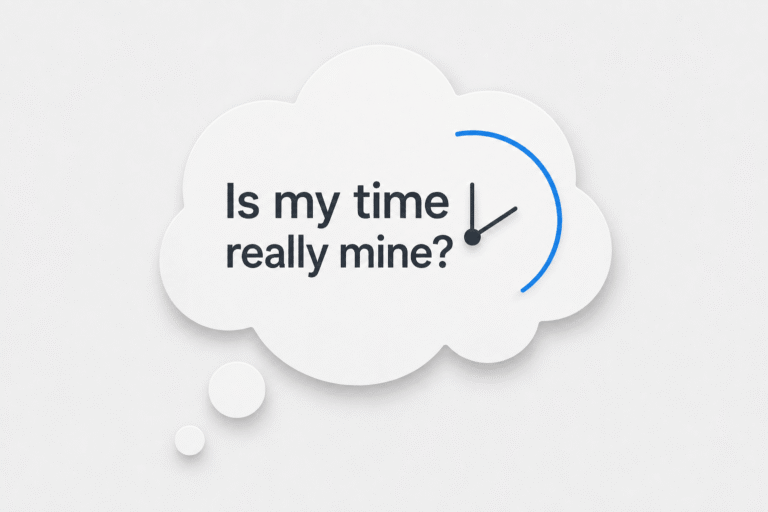
    Who Really Controls My Time?

    Not only time in the practical sense, like schedules, appointments, work hours, and daily routines. I mean time in a deeper sense. The time we actually feel we own. The time we can choose how to use. The time we have with our family, our health, our interests, our growth, and the things that matter to us.

    At some point, I began asking myself a simple but uncomfortable question:

    How much of my time do I really control?

    That question is not meant as criticism toward any job, business, career, or lifestyle. There is no right or wrong answer that fits everyone. Some people love their work. Some people enjoy being employed. Some people enjoy running their own business. Some people want stability. Some people want more freedom. Some people want a combination of both.

    But I think it is still a question worth asking.

    Because many of us grow up inside systems that shape how we think about time, money, work, and security. Often, we do not question those systems because they feel normal. We go to school, we are encouraged to get an education, find a good job, work hard, pay our bills, take vacations when possible, and build a life around that structure.

    There is nothing wrong with that.

    But it may not be the only way to think.

    When I was younger, I mostly saw two ways of earning money. Either you became employed, or you became self-employed. That was the world I understood. If you wanted income, you worked. If you wanted more income, you worked more, became better at what you did, or started your own business.

    I started working early. I had different small jobs when I was young, delivered advertising and newspapers, and later worked in the kitchen and dish area on a passenger boat. I learned very early that money usually came from exchanging time for income.

    Again, there is nothing wrong with that. It is how most of us begin. It is how most of society is structured.

    But later in life, when I was introduced to personal development and new ways of thinking about money, time, and business, I began to see something I had not really understood before.

    There is a difference between earning money from the time we sell and building something that can create income beyond the exact hours we personally work.

    That idea changed how I looked at time.

    As an employee, someone else usually decides many parts of the schedule. When to start. When to finish. When vacation is possible. What needs to be done. Where the work happens. How flexible the day can be.

    As a self-employed person, there may be more freedom in some areas. But even then, time is often connected to customers, assignments, deadlines, projects, and the need to keep producing income. In many cases, it is still an exchange of time for money, just in another form.

    That does not make it bad. It simply means that freedom and income are not always the same thing. A person can earn a good income and still have very little control over their time. A person can own a business and still feel trapped by the demands of that business. A person can have a stable job and still wonder what would happen if something changed outside their control.

    That is one of the reasons I believe this topic matters.

    Life can change quickly. A company can reorganize. A customer can disappear. A market can shift. A political decision can affect an industry. A health issue can change what is possible. An economy can move in a direction no one expected.

    Sometimes things happen that affect our entire lifestyle, even if we did nothing wrong.

    That is why I no longer think only in terms of income. I think more in terms of options.

    Do I have options?

    Do I have a buffer? Do I have more than one way to create income? Do I have skills that can help me adapt? Do I have something I am building for the future? Do I have enough control over my time to live in a way that feels meaningful to me?

    Those questions are not always comfortable, but they can be useful.

    For me, this is not about telling anyone to leave their job, stop running their business, or change everything immediately. That would be too simple, and life is rarely that simple.

    For me, it is more about awareness.

    Maybe the first step is not to change everything. Maybe the first step is simply to notice how life is structured.

    How much of my week is truly chosen by me? How much is controlled by obligations? How much of my income depends on one source? How much of my time goes to things I say are important, but rarely prioritize? How much of my life is built by design, and how much is simply the result of habits, routines, and expectations I never questioned?

    These are important questions because time is not just a practical resource. Time is life.

    Time with family. Time with children. Time for health. Time for learning. Time for reflection. Time for meaningful work. Time for adventure. Time to become the person we want to become.

    Many people say they want more freedom, but freedom is not only about money. Money can help, of course. But freedom is also about having choices. It is about not being completely dependent on one situation, one employer, one customer, one system, or one way of earning income.

    That is why I believe building alternatives can be so valuable.

    An alternative does not have to be dramatic. It can start small.

    It may be learning a new skill. It may be reading and studying personal development. It may be building better financial habits. It may be saving a percentage of income. It may be investing in knowledge. It may be creating a small project on the side. It may be developing a business slowly over time. It may be building something today that creates more choices tomorrow.

    The point is not that everyone should do the same thing.

    The point is to begin thinking differently.

    If I love what I do today, that is wonderful. But I still want it to be a choice, not a trap.

    If I choose to stay in a job, I want that choice to come from clarity, not fear.

    If I choose to run a business, I want to build it in a way that creates more freedom, not less.

    If I choose to spend my time in a certain way, I want to know that it is aligned with the life I am trying to build.

    That, to me, is the real question.

    Not whether employment is good or bad. Not whether business is good or bad. Not whether one path is better than another.

    The real question is: Am I building a life where I have options?

    Because when we have options, we can make better choices. We can stay because we want to, not because we are trapped. We can work because it is meaningful, not only because we have no alternative. We can build slowly without panic. We can think longer term. We can make decisions from a place of strength instead of fear.

    I think that is one of the reasons personal development has meant so much to me. It opened my mind to the idea that life does not have to be viewed only through the structure I grew up with. It helped me understand that habits, thinking, skills, leadership, communication, and financial awareness all play a role in creating more options.

    And maybe that is where the real value begins.

    Not in suddenly changing everything.

    Not in judging anyone else’s choices.

    But in asking better questions.

    What kind of life am I building? Where does my time go? What am I depending on? What would happen if something changed? What could I start building now that might give me more choices later?

    For me, this reflection comes back to one simple idea:

    I want to own more of my time.

    Not because I want to escape responsibility, but because I want to live with more intention. I want my time, work, income, habits, and growth to move in the direction of the life I actually want to build.

    Maybe that is something worth thinking about.

    Because if time is life, then learning to create more choice around our time may be one of the most important forms of growth.

    Related reading: Creating more control over your time often starts with small daily habits. Read: Are Your Habits Changing Your Life?

    Want to understand how your choices shape the way you use your time? Learn more about the Decision Style Test.

    Was this article helpful?
    YesNo